|
Past reviews are archived - 
"HairSpray" at the North Shore Music Theatre Rating 5+
"Mamma Mia!" at the North Shore Music Theatre Rating 5+++
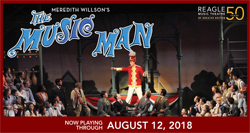
"The Music Man" at The Reagle Music Theatre Rating 5 "Peter Pan" at the North Shore Music Theatre Rating 4.5

"THE TAMING" at Club Café Rating 2 
"A CHORUS LINE" at The Reagle Music Theatre Rating 5 The Reagle Music Theatre of Greater Boston opened its season with the immensely popular A Chorus Line, which first opened on Broadway in 1975. A Chorus Line takes the audience into a seemingly authentic casting call for the triples threats – someone who can dance, sing and act. The director, primarily heard from a speaker, wants more out of these auditions by requesting each candidate reveal, not only their reasons for becoming dances, but their sometimes-painful journey in reaching their goals. The simplicity of the scenery consisting of a black wall interchanging with mirrored panels is more than enough to showcase each dancers' stories, and dancing abilities. As with any audition, there were strong performances, as well as some which were considerably weaker. The cast consisted of 17 characters from all areas – including one from Boston – and from an array of different backgrounds. Most characters had their strong points. The strongest dancers were 2 of the male cast members. Bernie Baldassaro, and Ashton Lambert, respectively as Larry the Dance Captain, and Mike – who took his sister's failure in dance as his opportunity, were definitely the most exciting choreographed performances of the show. Lauren Gemelli was outstanding as the (alternate) Sheila, the dancer who was "going to be 30 real soon…and was real glad". Her attitude as an older dancer was undeniably convincing, and her vocals were strong and distinctive. Another vocally amazing cast member was Victoria Byrd who played Maggie. Her main contribution was as a part of the trio who sang of the importance of ballet as an influence to become a dancer. They described in song how "everything was beautiful at the ballet", in contrast to their unhappy childhoods. The best acting job was unequivocally from Makai Hernandez, as Paul – who began his dance career, forced into an area of performance which was distasteful to him, and shocking to others. His background story was told simply, with increasing emotion, which undoubtedly touched the audience with it's authenticity Sydney Parra as Diana demonstrated beautiful vocals describing her difficult experience in acting class, as well as the well-known and hauntingly emotional solo "What I Did For Love", conveying the love of dance when imaging a time when that love is no longer. Kudos as well to the adorable couple Al and Kristine, played by Thomas Doegler and Charlotte Hovey. They demonstrated terrific comedic timing, and nice vocals when dealing with the frustration of Kristine's inability to sing. Dancer Cassie (Kirsten McKinney), the former love interest of Director Zach (Scott Wahle) provided lukewarm performances. McKinney's vocals were demure, and simply not strong enough for the role. Her dancing was better than average, but again, a shade weak for this part of Cassie, a dancer far too special for the chorus line. Zach was behind the scenes for most of the performance, but at times it felt as if he were reading from his script without sufficient emotion. Ansley Speares was cast as the most provocative character Val, singing the infectious "Dance 10; Looks 3". It simply didn't work on many levels as the energy was lacking, as well as poorly selected costuming. She received polite applauses for her performance, contrary to the robust cheers and clapping for the other performers. Keeping the final cut under wraps, the finale – including the appearance of all dancers - was spectacular. I am sure many of the audience members wanted to get up and join in on "One" – or at least go home and learn the steps on YouTube in the privacy of their homes Besides some acoustical glitches – some weaker microphones where the voices were drowned out – A Chorus Line was thoroughly entertaining, and "sensational" show. A Chorus Line was the winner of nine Tony Award nominations in addition to the 1976 Pulitzer Prize for Drama. With music by Marvin Hamlisch, lyrics by Edward Kleban and a book by James Kirkwood Jr. and Nicholas Dante. A Chorus Line was produced and directed by Robert J. Eagle, with musical direction by Dan Rodriguez, and choreographed by Leslie Woodies. A Chorus Line will be running until June 17 at the Reagle Music Theatre of Greater Boston located at 617 Lexington Street, Waltham, Massachusetts. For additional information, please visit www.reaglemusictheatre.com or call 781-891-5600.
"MAME" at the North Shore Music Theatre Rating 5 Opening night at North Shore Music Theatre led promise to the 2018 season with its premier selection of Mame. This primarily upbeat, lighthearted story of Mame Dennis, an eccentric socialite, who adapts her lifestyle when her young nephew is orphaned and comes to lives with his flamboyant aunt. Mame made its debut in 1956 on Broadway, and starred Golden Globe recipient Rosalind Russell, who later starred as Mama Rose in Gypsy with Natalie Wood in 1962. The musical version of Mame opened on Broadway in 1958 and starred Angela Landsbury and Bea Arthur. Beautifully scored by Jerry Herman, Mame features the ever popular "Mame", the amusing "Bosom Buddies", and the lovely "My Best Girl". In the starring role of Mame was Paige Davis, best known as a television personality and actress. She has served as the host of Trading Spaces, for TLC's popular home improvement program from 2001 until 2008. Her vivacious personality owned the role and provided a perfect persona as Mame Dennis. A vocal alto, Ms. Davis could be considered an actor who sings, rather than a singer who acts. Although her voice was not spectacular, her voice was true. Her energetic and genuine performance evoked enough likeability, and she shined in the role. Jake Ryan Flynn was endearing in his role as Mame's nephew Patrick. His vocals were sweet, and his acting range was impressive. Flynn has an impressive array of credentials, for his 9+ years of life. Appearing on Broadway, television appearances, and commercials, young Mr. Flynn is certainly an impressive young actor who will continue to grow his craft. David Coffee made an appearance as a secondary character Dwight Babcock. As always, Mr. Coffee does a fine job with his character. He covers his part within his range and delivers a solid performance. Ellen Harvey as Mame's friend Vera Charles was thoroughly entertaining, whether playing her part drunk or sober. She was the perfect counterpart to Mame, as well as a convincing, warm friend with the right amount of love and sarcasm demonstrated in their duet "Bosom Buddies" an amusing duet with Mame. Lauren Cohn as Agnes was the sleeper of this performance. Upon her first appearance, she was mousey, bland, and offered acceptable vocals. However, once under the spell of Mame, and taking her advice to live a little, Cohn's transformation was astonishing as she showed impressive comedic timing, and crazy vocals lending to a completely entertaining performance. The secondary characters and ensemble cast gave a credible performance in within many of the scenes with interesting characters, and harmonic vocals. The dancing was simple and fun to watch, with lovely colored costumes, reminiscent of the flowers of spring. This light and classic production certainly kicked off what appears to be a fabulous season at North Shore Music Theatre. Mame will be running until Sunday, June 17
Directed by Charles Repole and Milton Granger with Choreography by Michael Lichtefeld, , "Mame," with the book by Jerome Lawrence and Robert Edwin Lee and music and lyrics by Jerry Herman. Information: (978) 232-7200 or visit www.nsmt.org. EVITA The opening night of EVITA at North Shore Music Theatre on September 27, 2017 could only be described as WOW! In my humble opinion – anything by the team of Tim Rice and Andrew Lloyd Webber is always brilliant. But it also takes a phenomenal group of performers to bring it all together.
YOUNG FRANKENSTEIN I attended The North Shore Music Theatre in Beverly production of The Mel Brook's Musical Young Frankenstein on August 16. One of my favorite Mel Brooks movies, combining humor and horror, I anticipated this musical production as a triple threat. This production did not hold back in any way. Upon entering the auditorium, the theme of the production was apparent with adornment of ghoulish décor, gothic candlesticks, and a soundtrack of howling winds, and claps of thunder&hellip..and yes – lighting bolts. This introduction alone, was not for the faint of heart. Surprisingly, the stage was set with a circular curtain – the first of approximately 25 shows I've reviewed, which actually utilized curtain, albeit not traditional, as a silhouette of the castle of Dr. Frankenstein amid dark clouds hovered in the distant mountainous terrain.
BEAUTY AND THE BEAST Wednesday July 12 was the opening night of BEAUTY AND THE BEAST at The North Shore Music Theatre in Beverly. This beloved Disney classic was performed impeccably, and perhaps was one of the top shows in talent, and visual spectacles I've reviewed in at the North Shore Music Theatre.
SHOWBOAT July 7, 2017 was the opening night of the SHOWBOAT, the Jerome Kern and Oscar Hammerstein award-winning musical, at the Regal Music Theatre in Waltham. Based on the 1926 novel SHOWBOAT by Edna Ferber, the controversial and historical story centers around the relationships between performers, stagehands, and dockworkers, along with some of the prejudices between blacks and whites. This is also juxtaposed by love stories, some traditional, some poignant, and some radical. The primary stories focuses on the relationships between Nola (Magnolia) and Gaylord, and Julie and Steve, in which both face their own demons despite each women's dedication to "loving that man of mine" from the now classic song, "Can't help lovin' dat man of mine." SHOWBOAT is fraught with emotion, and accompanied by the stirring musical score. Although the entire story provides a combination of romance, humor, and pathos, this production of SHOWBOAT contained a mere five minutes of musicality so spectacular, that it would be worth the price of a ticket just to experience that one musical number. As part of the first scene, Michel Bell as Joe sang "0ld Man River", a song which equates the struggle of the black people with endless and uncaring flow of the Mississippi river. Bell's superb, and heartfelt vocals created actual chills in his power and delivery. When joined by a harmonizing trio, did not deflect from the magnificent vocals by Bell.
THE MUSIC MAN Wednesday, June 7 was the opening night of THE MUSIC MAN and the beginning of North Shore Music Theatre's summer season. Bill Haney, owner and producer of the theater wanted to start the season with a "big slice of Americana" as the start to the North Shore Music Theatre's 60th season. COYOTE ON A FENCE Hub Theatre Company
I attended a performance of Coyote on a Fence presented by the Hub Theatre Company of Boston on April 1, 2017. Written by award-winning writer Bruce Graham, Coyote on Fence was originally produced at Cincinnati Playhouse in 1998. (My Grade: 5) Coyote on a Fence written by Bruce Graham, and directed by Daniel Bourque, is playing through April 15th, at the First Church in Boston, 66 Marlborough Street, Boston, MA. All tickets to all shows are pay-what-you-can afford. For additional information, please visit their website at The Hub Theatre Company of Boston FIDDLER ON THE ROOF I attended the opening night of Fiddler on the Roof at the NewRep Theatre in Watertown, MA on December 5th. It has been years since I first fell in love with this musical, when my parents took me both for entertainment, as well as to reiterate traditional values. As in some of my other favorite musicals I cherish, I knew viewing Fiddler on the Roof objectively would be moderately challenging. I have been successful in allowing myself to overcome the familiar, as I detach myself to observe a performance at face value, allow the story to be told with musical accompaniment, without comparing to better known productions. Director Austen Pendelton did a wonderful job in recreating this award winning musical, utilizing a younger cast, and producing Fiddler on the Roof as slightly more modern in comparison to the 1971 movie. WEST SIDE STORY I attended a delightful performance of West Side Story at North Shore Music Theatre on November 2. Taking on a production such as West Side Story was certainly a challenge considering the popularity of 1961 musical which earned 11 Academy Awards, and featuring the outstanding talents of the late Natalie Wood, Richard Beymer, Rita Moreno, and George Chakaris. These were certainly huge shoes to fill… As North Shore Music Theatre utilizes a variety of talents ranging in local to veteran, they wisely chose create their own version of the immensely popular musical. Even for someone who places West Side Story as something beyond re-creation could watch NSMT presentation with admiration at their ingenious adaption, which was by simply using fledgling actors and actresses. Although the cast had considerable stage experience, they were primarily a decade or more, younger than the original cast. The talent was apparent, as each player did not attempt to mirror an untouchable classic. The cast in its entirety was fresh, original, and brought a youthful energy to the stage. MONTY PYTHON'S SPAMALOT I have been reviewing performances at the North Shore Music Theater in Beverly, among other venues, for several years. On September 28th, I attended the opening night of Monty Python's Spamalot, which, I have to say, was the best performance of anything I have had the privilege to review to date. From its superbly funny screenplay performed by an immensely talented cast, every minute of Spamalot was entertaining. Unlike any other comedic production, Monty Python offers a script which is literally a laugh a minute. Each line is hilarious. And each (primarily R-rated) utterance was delivered clearly, with impeccable timing from the cast. This was the type of production you would want to go back and see the next day, as it was so original and fun. I had reviewed Spamalot a few years ago, and this production was freshened up, as well as enhanced by lines and imitation of an important current events and people now in the forefront of everyone's mind. Although in a different political arena, it was too tempting to ignore touching upon our news worthy notables. Suffice to say, building a wall around Camelot was a side-splitting solution. THE GOOD BODY
I reviewed The Hub Theatre Production of Eve Ensler's "The Good Body", on July 22, 2016, which was performed at Club Café, 209 Columbus Avenue, Boston. "The Good Body" is based on Ensler's critically acclaimed 2013 memoir. MARY POPPINS I was very much looking forward to North Shore Music Theater's production of Mary Poppins. This 1964 classic children's production combined whimsical fantasy, colorful adventures, and a wonderful, sing-able musical score. It also introduced us to Julie Andrews, as Mary Poppins. With her rosy cheeks, ability to play games - all sorts- and of course, her perfect soprano, she was the consummate caregiver. I was only 7 when I first saw the movie and it was also my first introduction to the elegance of a proper English accent. A budding young actress and impressionist since a mere three - I readily mastered the accents, and was thrilled when my parent's hired Kay, a wonderful English housekeeper - although lacking in magical abilities. The magic of Mary Poppins brought the lovely London flavor to Beverly, Massachusetts this summer, with its own rendition of this iconic movie. Each character was portrayed flawlessly. FUNNY GIRL As a musical theater aficionado I have immensely enjoyed reviewing many creative productions. While I eagerly anticipate an opportunity to review a show absent from my repertoire, I also enjoy seeing familiar productions, and each theater company's creative and interesting interpretations. I am cognizant to view these familiar shows with an open mind without comparing any troupe member to the original performers. Therefore, I was so much looking forward to seeing the North Shore Music Theatre's performance of the much loved "Funny Girl", a longtime favorite of mine. 
"RENT" at the Suffolk University Theatre Department Suffolk University Theatre Department is performing RENT, which will be the final production in the C. Walsh Theatre. The loss of their performance space parallels the theme of loss in Rent, which tells of loss and survival during the AIDS epidemic, set in an abandoned building in New York. RENT was primarily a workshop presentation in 1993, later opening Off-Broadway, the evening following the death of writer, lyricist, and composer Jonathan Larson from complications from AIDS. RENT went on to opening on Broadway in 1996, and winning the Tony Award for Best Musical, in addition to other awards, including a Pulitzer prize. Loosely based on Giancomo Puccini's opera La Boheme, RENT is the story of a group of friends struggle to survive, socially, economically, and personally as they deal with their own issues, including homelessness, drug addiction, and HIV/AIDS.
"RENT" at the Back Bay Events Center The Fiddlehead Theatre company is performing RENT, to honor the memory of writer, lyricist, and composer Jonathan Larson, before succumbing to the AIDS virus. RENT was primarily a workshop presentation in 1993, later opening Off-Broadway, the evening following the death of Jonathan Larson from complications from AIDS. RENT went on to opening on Broadway in 1996, and winning the Tony Award for Best Musical, in addition to other awards, including a Pulitzer prize. Loosely based on Giancomo Puccini's opera La Boheme, RENT is the story of a group of friends struggle to survive, socially, economically, and personally as they deal with their own issues, including homelessness, drug addiction, and HIV/AIDS.
SISTER ACT With anticipation and curiosity, I attended the opening night performance of Sister Act at the North Shore Music Theater in Beverly, Massachusetts. As a great fan of the 1992 movie of the same name, starring Whoopie Goldberg, I was curious to see how that would adapt onstage, particularly in the theater-in-the-round. Sister Act was one of the most financially successful comedies of the early 1990s, so there were big shoes to fill.
BILLY ELLIOT The Musical I attended opening night of BILLY ELLIOT The Musical at the North Shore Music Theatre in Beverly, MA. My acquaintance with the 2000 movie version of "Billy Elliot" was limited. Other than knowing the score was composed by Elton John, partnered with a story about a young boy who wishes to become a ballet dancer, I was unprepared for this incredibly moving and mesmerizing event. This production impressed me so much, I need to open this review with my stellar congratulations and kudos to 14 year old Nicholas Dantes (Nic) in the leading role. Skinny, baby faced and exuding innocence, Nic offered a powerful, triple threat performance. It was difficult to believe Nic has only been dancing for three years as his technique and motions were of a much more seasoned dancer. In addition to sweet vocals, his portrayal of young Billy was endearing, and genuine. Nic has recently been nominate for a Best Actor in a Principal Role in Chicago, and is scheduled to reprise this role in Jupiter, Florida this winter. Clearly a talented and focused young man, I am looking forward to watching him as his career soars. Saturday Night Fever
I attended the premier presentation of Saturday Night Fever at the North Shore Music Theatre in Beverly. Directed by Richard Stafford, choreographed by Nick Kenkel, with musical direction by Milton Granger, this staged presentation was based on the 1977 movie by the same name, which exploded onto the disco scene, and featured a soundtrack by the Bee Gees, KC and the Sunshine Band, and other artists, becoming an international music phenomenon, garnering many awards, and becoming a platinum selling record. Curiosity abound how this historical iconic film would translate onto the stage. As a former disco dancing Queen, and tremendous fan of the movie viewed many times, I knew it was important to utilize a fresh outlook on this new production, without too much comparison to the hugely commercially successful original. The audience was clearly as intrigued, as it was comprised of the former disco generation, including a quartet of men colorfully garbed in traditional disco outfits.
"Kiss Me, Kate" at the The Reagle Music Theatre Waltham's Reagle Music Theatre's summer performance of Kiss Me Kate, enjoyed a full house performance on July 10. The successful musical Kiss Me, Kate originally opened on Broadway in 1948 and won five Tony Awards in 1949. With music and lyrics by Cole Porter, and book by Sam and Bella Spewack, the predictable love story was cleverly woven into a performance within a Shakespearian performance. "Shrek The Musical" at the North Shore Music Theatre I saw a delightful performance of Shrek The Musical at Beverly's North Shore Music Theatre on July 8, 2015. I enjoyed the movie version of Shrek, which won an Academy Award For Best Animated Feature which held fond musical memories for me, watching the adaptation for my daughter's dance recital at age 4. Now at age 17, she was eager to take the trip down memory lane and determine if it still delivered the same wonderment. We were not disappointed. 
Shiver: A Fairytale of Anxious Proportions An original production, based on The Brothers Grimm Fairytale of "The Story of a Boy Who Went Forth to Learn Fear", writers Nina Louise Morrison and Cecelia Baker, was presented in the Boston Playwrights' black box theater. Arranged with stadium seating, and tiny platform stage, the audience was intimately seated on moveable plastic seats. The show was scheduled to run for 75 minutes, but started about 15 minutes late. The story line by Jacob and Wilhelm Grimm, was one of their less known fairly tales. The brothers worked at preserving the old German folk tales. Much of their work contained violence, as well as sexual innuendoes, according to Sigmund Fried, and Erick Fromm, who examined these stories in the 20th century.
"DREAMGIRLS" at the North Shore Music Theatre
North Shore Music Theatre in Beverly opened its 60th season on June 3, 2015 with the 1981 musical DREAMGIRLS. With book by Tom Eyen, and music and lyrics by Henry Krieger, DREAMGIRLS was the winner of 6 Tony Awards, and adapted into a motion picture in 2006.
"Les Misérables" at the North Shore Music Theatre
I attended a performance of Les Misérables Beverly's North Shore Music Theater on October 30, 2014. This was the final scheduled show of the 2014 season, and certainly the most ambitious undertaking, especially with a cast consisting of performers making their debut to NSMT. But this new cast of performers, from the very first notes, did not show a shred of difficulty in the unique setting. The theater-in-the-round stage was hauntingly vacant of any props except for distressed wooden shutters hanging high, alit with tiny candles. Smoke seeped from the bottom of the stage, lending to the atmosphere of oppression of the criminals of the 19th century French prisons where inmate
Jean Valjean receives words of his release. His difficult transition from a free man who still bears the marks of a former criminal, to respected political figure, friend, father, and hero was set against the backdrop of the French revolution. Consisting
wholly of musical interpretation, every moment was compelling and flawless. The orchestra was the largest of any production, consisting of 14 pieces, and conducted splendidly by Andrew Bryan. 
"AIDA" at the Strand Theatre With great anticipation, I attended the opening night of the Fiddlehead Theatre Company's Tony award-winning production of AIDA at the Strand Theatre in Dorchester. AIDA is a contemporary musical based on the opera Aida
by Giuseppe Verdi. This modern version was a collaboration of the talents of musical genius Elton John, and brilliant lyricist Tim Rice. A long time fan of both, I was eager to hear the creation of this union.
"CHICAGO" at the North Shore Music Theatre Chicago made a vibrant appearance at the North Shore Music Theater in Beverly, Massachusetts. A trip back in time, where "jazz and liquor" were in the forefront of the burlesque theaters and salons in the 1920's Chicago, was a seamless and thrilling journey; the perfect folly for a Sunday afternoon matinee. The story of siren Velma Kelly and wanna-be Roxie Hart joined forces as nemeses' turned allies with entertaining song and dance, and clever pas-de-deux. The combination of music, dance and humor was brought to life in the theater-in-the-round during the 2 hour performance.

"Pygmalion" Performed by Flat Earth Theatre Company I attended opening nights at the Flat Earth Theatre production of Pygmalion at the Arsenal Center for the Arts. The performance space was a black box theater setting. The black box has progressively gained popularity for small theatrical performances in recent years. Untraditional, yet often providing creativity with the sets, this production of Pygmalion was simplistically set in a direct contrast to a show known for its elaborate and elegant scenery. Although Pygmalion was the premise for My Fair Lady, the setting was a bare outline of the London underground transit map, and the remainder of the set consisted of park benches, which were moved periodically by the cast in random arrangements. The few props looked tired, and haphazardly selected. Perhaps it may have worked if the cast had been stronger.
"The Little Mermaid" at the North Shore Music Theatre It was with great anticipation I attended the opening night performance of The Little Mermaid at Beverly's North Shore Music Theater on July 10, 2014. The theater in the round always has a unique way of setting the stage, but in the premier production or The Little Mermaid, they outdid themselves with their creativity. The minimalist effects of draped seaweed combined with ripples of light, and blue clad dancers waving schools of fish was so convincing, you could almost smell the brine. Along with the sound effects of bubbling water, it took little effort to feel as if we were privy to a fantastic undersea grotto. 
"Me and My Girl" at Reagle Music Theatre
I attended Me and My Girl on July 11, 2014 at the Reagle Music Theatre. I was unfamiliar with this production, which debut in England in 1937, and finally became a Broadway with numerous Tony award following its American revival in 1986. I was totally surprised, as nothing could have prepared me for this truly delightful and hilarious performance. "Anything Goes" at the North Shore Music Theatre The North Shore Music Theatre began its 2014 season reviving a show that debuted in 1934, and subsequently achieved its place among the classical musicals. Freshened up in 1987, the young cast at North Shore Music Theater was clearly energetic and talented. An old-fashioned theme of girl loves boy, who love other girl, who loved other boy was fun and modern. With music and lyrics by Cole Porter, the array of songs definitely stood the test of time with the ability to entertain. 
"South Pacific" at Reagle Music Theatre
I attended South Pacific on June 13, at the Reagle Music Theatre, located in the Waltham High School. Despite its unorthodox location, Reagle Theatre has earned the reputation of producing some top notch shows with a variety of talent, both local and national. The productions certainly rival any Boston show, clearly apparent by the number of patrons who attend productions, and there is usually a full house. 
"Lebensraum" by Israel Horovitz
Lebensraum by Israel Horvitz enjoyed an opening night performance at The Factory Theatre in Boston on May 9, 2014. 
"Breaking the Shakespeare Code" Breaking the Shakespeare Code by playwright John Minigan enjoyed an opening night performance at The Factory Theatre in Boston on March 6, 2014.
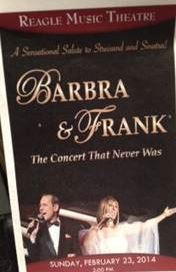
"Barbra and Frank: The Concert That Never Was" I attended Barbra and Frank: The Concert That Never Was on February 23rd at the Reagle Music Theatre in Waltham, Massachusetts. This performance was special, as it was a one-time event, as well as a fantasy concert because Barbra and Frank never appeared together. The bare bones lobby was filled to capacity with an eager audience with an assumed median age of 70. This was the generation that was raised with Frank Sinatra and remembered him as a skinny kid with blue eyes and a smooth vocal style. They were the same cohorts that first saw Barbara Streisand appear as an assuming prospective singer on The Tonight Show with Jack Paar in 1961, until she proved that she possessed an extraordinary talent. Both creating fan base that was impressive, and still loyal as the palatable anticipation upon entering the auditorium was clearly apparent. 
"SPANK! Harder" at The Wilbur Theatre Out of curiosity, I attended "Spank! Harder" at the Wilbur Theater in Boston. This was a sequel to the original show "SPANK", a parody loosely based on the book by E.L. James, British author of the erotic trilogy Fifty Shades of Grey. 
"COMPANY" I recently attended the Moonbox Production of Company. It was performed in a black box theatre, a modernistic venue, which allows a variety of staging and seating. This contemporary approach to staging has been becoming the norm as it allows a smoother performance, as well as much more variety for each show. Not surprisingly, the setting for Company was completely different from the prior production in regard to staging and seating. Although the scenery was sparse, the creative setting of raised platforms allowed for an effective design and separation of scenes. The 9 piece band, comprised of musicians clad in black and seated against a black wall, blended into the production, without disrupting the action, despite being visible from start to finish. As Company is a modern piece, the costumes for the cast were generic and familiar to a thirty-something age group. I was especially eager to review this show as I was familiar with the music of Stephen Sondheim, but unfamiliar with this show. Sondheim's compositions are a completion of quirky, unusual, and melodic. As an avid listener of the weekend radio show Standing Room Only on WERS, I soon realized I was indeed familiar with some of the music performed in Company, as well as a fan. The introspective storyline gave the audience privy to the balance and disproportion in relationships between men and women. Happy or sad, married or single; the continuous theme posed the age-old debate between individuals who decide to marry, commit to stay married or prefer to remain single. Each couple gave the sole single man, Bobby, a different perspective of their lives as well as causing him to analyze, debate, consider, and explore his options on the eve of his 35th birthday. David Carney as Bobby was spot on with his character interpretation. Right down to his physicality on stage, Carney was believable as a single man second guessing where he was at that moment of his life. His vocal abilities walked the line of adequate to somewhat bothersome, as he drifted into nasal tones. But as Bobby, he was "cute", likable and his vulnerability was authentic, so where he lacked in vocals, he made up for in his acting. Contrary to Carney, Bobby's older friend Joanne, played by Leigh Barrett was the shining star. Although at first somewhat matronly and subdued, she eventually let down her guard and showed a cougar who was somewhat bored with her marriage, as well as frustrated that there was nothing more. Her solo, "The Ladies Who Lunch" was fantastic, both vocally as well as emotionally. Another super vocal performance was given by Teresa Winner Blume, as Jenny. Although her primary role was a petite and adorable wife, she had the opportunity to display her classically trained vocal talents in my personal favorite piece, "Not Getting Married", an amusing duet with Blume as the minister and Amy, (Shonna Cirone) as the panicked bride. Cirone sung her difficult part amazingly well, conveying pre-wedding jitters bordering on hysteria with her rapid yet precisely annunciated words. Katie Clark as April, the flight attendant who shared occasional liaisons with Bobby, was familiar to me as I saw her performance at the Reagle Theater playing Cassie in A Chorus Line. Clark is not a typical ingénue physically, and initially a surprising selection for Cassie. Yet, Clark's talent for acting, dance and vocals was impressive in both productions. She portrayed April as ditzy, but wanting love, contrary to her former character of Cassie, where she was sharp and had abandoned love. Each role was at opposite ends of the spectrum and Clark's ability to cover both roles demonstrated her notable range. Marta, another woman Bobby dated, was played by Megan Alicia. Her bohemian character was affable and genuine. Her vocals were slightly muted and I was unsure through most of her songs as to her true vocal talent. Sitting fairly close to the stage, I was able to appreciate Alicia's voice albeit wished for a clearer delivery. This may have been attributed to the intimate setting of Moonbox and the difficulty in creating a balance of sound as it was a tad problematic. Act II of Company was much darker than Act I, incorporating the sad futility of aging, homosexual and extramarital invitations, and a fairly explicit bedroom scene. Although Lisa Dempsey, playing Kathy, danced beautifully beside the couple writhing on the bed, she was clad in a short, diaphanous nightgown. It was a little confusing as to her part in that scene and many of the audience members were clearly shocked during this part of the show. It was an extreme contrast to the beginning, and subsequent ending of the show, and I felt it could have been done a little more tastefully. The remainder of the supporting cast played their roles adequately, and completed a fairly tight vocal ensemble. Although their roles were smaller, collectively, they were wonderful Company sharing Bobby's birthday celebration and a brilliant Sondheim score that stayed with the audience as they exited the theater humming the catchy melodies. Moonbox Productions use their performances to raise awareness to non-profit organizations. This production was to benefit Music for Food, a musician-led initiative to fight hunger in our home communities. Located in Boston, Music for Food has established relationships with hunger relief organization that benefit from the proceeds raised during a variety of performances. For additional information, please go to their website at www.musicforfoodboston.org. Please be aware that the parking situation in Boston's South End on a Sunday afternoon is extremely difficult. There are few non-residential parking spaces, a garage around the corner from the theatre that quickly fills, and limited metered spaces. Evening parking in the area is much more forgiving. Directed by Allison Olivia Choat, with Dan Rodriguez as the Music Director, "Company", with words and music by Stephen Sondheim and book by George Furth is at Boston Center for the Arts Plaza Theatre, 527 Tremont Street in Boston's South End through March 1. For tickets call Boston Theatre Scene Box Office at 617-933-8600 or online at www.bostontheatrescene.com. For more Company information visit www.moonbox.org. My Grade: 4
"A Christmas Carol: A Musical Ghost Story" I attended the North Shore Music Theatre production of A Christmas Carol: A Musical Ghost Story on December 7th, 2013. This show is based on the work of Charles Dickens and has been televised in many different formats over the years, including an animated version with the late Jim Backus as Mr. Magoo. The theatre-in-the-round stage was set in a gloomy London street, that came alive during the opening scene with 1860's period costumed villagers joyously greeting one another with song in happy aniticpation of the Christmas holiday. The story of Ebenezer Scrooge was narrated by actor Ryan Bates who helped to move the story along, and fill in the details from Mr. Scrooge's recent unkind behavior and soured relationships. Ebenezer Scrooge was played by David Coffee who was enjoying his 20th holiday season in the role. Obviously well versed in the role, he was able to make it his own with expressions and inflections, even adding a touch of humor to an otherwise unpleasant man. A familiar face to NSMT, Coffee also performed in the summer production of The Wizard of Oz as the Wizard. The well known story of Scrooge is a lesson in Karma. Scrooge is shown that past actions determine one's future. He is informed that he needs to change his ways when he is visited by his deceased former business partner Jacob Marley, played by Matt Allen. Allen was truly frightening in this role. Dressed as the ghost of a ravaged old man and bound by the chains of the misdeeds of his past, Allen flew around the stage, tethered by these chains, accompanied by the sounds of howls, clatter and ominous clanging. With his ghoulish makeup, effective lightening, speech enhancements and pyro-techniques, his presence was quite startling. True to Marley's warning, Scrooge is visited by three ghosts, to show him his progression from a loving young man, to one who became obsessed with his love of money, rather than people. These ghosts, depicting past, present, and future were magnificently played by Leigh Barrett, Sheldon Henry, and Kevin Patrick Martin, respectively. Barrett's beautiful soprano heralded her entrance on a small moveable platform that rolled about the stage, assisted by the two "Pearlies" or stage hands. Wearing a white ethereal gown, she provided a gentle companion to Scrooge as he remembered the softer times in his life. Henry was grand in voice and statue as the ghost of Christmas present. Surrounded by bountiful fruits and plenty of the holiday, and wearing a royal red gown, with high platform shoes, Henry towered above the other characters, creating an effect that was both regal as well as progressively menacing. His demeanor paralleled Scrooge's day to day disagreeable attitude with a mocking edge. Martin was terrifying ghost as the ghost of Christmas future. Clad in a large black hooded shroud and chains, he didn't speak, but merely pointed out events that were in Scrooge's future, if he did not change his ways. No words were necessary, as the inference to his future was quite clearly marked on the headstone that slid into position from the floor of the stage. Mr. Scrooge's nephew Fred was played by Bronson Norris Murphy. Adequately pleasant and easily dismissing the ranting of his old uncle, Murphy was elegant and convincing. His wife Meg was beautifully portrayed by Stephanie Granade. Charming and graceful, with a lovely soprano, she was a shining star in her small role. The smallest character was Tiny Tim, who was played by Sarah Gillespie. The young actress handled the role of the ill boy with the appropriate amount of idealistic hope and childlike enthusiasm. This production had some of the most clever staging, scenery and music of all the NSMT productions. In a curtain less theatre, NSMT was easily able to add and remove scenery with the ability to create several different places within one stage. As the play was not a musical, a full orchestra was not needed. The few musicians sat in 2 platforms close to the ceiling. With horns, strings, a keyboard, and harp, the music was perfect in its melodies, short accompaniment and sound effects, particular the screeches of the violin. The story of a Christmas Carol is well known and has been performed on stage and screen for many years. The play was adapted from the Dickens book, het one piece that had been omitted in prior productions. It was quite surprising to learn that the Narrator of this production was Tiny Tim as an adult. Evidently Mr. Scrooge, who had become a giving man at the end, made such an impression on Tiny Time, he named his child Ebenezer. This production of A Christmas Carol was one of the best as well as the most frightening renditions I've seen. It's a holiday performance that should not be missed. Please note: there were several loud sound effects and bursts of flame that cause some flinching of audience members and therefore may be disturbing to some viewers. A Christmas Carol will be running until Sunday, December 22. Directed by Arianna Knapp and Musical Direction by Mark Hartman and choreographed by Joe Moeller. "A Christmas Carol: A Musical Ghost Story" from the Charles Dickens novella and adapted by Jon Kimbell is at the North Shore Music Theatre, 62 Dunham Rd Beverly, MA 01915. Tickets $45 - $75. Information: (978) 232-7200 or visit http://www.nsmt.org North Shore Music Theatre has an impressive lineup for next year's production. Beginning in June 2014, the following shows will run: Anything Goes, The Little Mermaid, Grease, Chicago, and Les Miserable. I am looking forward to another season of performances and reviews. (MY GRADE: 5) 
"Christmas Time" at Reagle Music Theatre I attended Christmas Time on December 6th at the Reagle Music Theatre. This is held in the auditorium of Waltham High School. The lobby looks like a typical high school, but prior to the performance, a choir dressed in colonial garb sang an impressive medley of a Capella Christmas Carols. Upon entering the auditorium, the audience was greeted by an exceptionally large hall and stage, enhanced by a red velvet curtain and a very lovely lighted displace of snowflakes, and garland aligning the walls. Upon reviewing the program, there was no description of the performance or story line. There were only lists of well known Christmas classics as well as several lists of the names of the 200 performers divided into groups of singers, dancers and characters. I learned from a nearby audience member that this production was a holiday event specifically put together for the Reagle Music Theatre using local talent. There was a live orchestra accompanying the performers, and they began with an overture of Christmas songs. The opening processional began with the choir robe clad chorus lining the aisles with light-bulbed "candles" singing a medley that began with the Latin Kyrie Elysian and ending on stage with a portion of Handel's Hallelujah Chorus, which was fantastic. This brought back fond memories of my high school years in concert choir with my first exposure to liturgical pieces. The show continued with renditions of holiday songs performed with beautifully recognizable scenic backdrops depicting Central Park in New York, the Boston Common, as well as Santa's workshop, and Waltham retail areas, including the former Yolanda's Bridal, a Waltham landmark of 41 years. Although the scenes were independent of each other, the performance flowed seamless from song to song to dance. Each piece created another lovely aspect of the holiday, from standard to whimsical. The cast ranged from very young children to adults, all equally entertaining. The youngest performances were nothing less than adorable in their vocals and dances. There were many standout performances, including 16 young Santa's-in-training simultaneously playing Jingle Bells on xylophones. There were huge costumed bears, ranging from teddy bears, to kolas and pandas, culminating in a short piece from The Nutcracker, featuring a graceful Kailan Bernat as Clara. Christmas Time covered almost every aspect of the holiday in many different and sometimes unique venues. There was an impressive Barbershop quartet performance. The audience was treated to 8 lighted Christmas trees that glowed as they danced in the dimly lit theater. A group of "Rockettes" performed several times. Although their kick line did not rival the New York dancers, their performance was concrete and inspiring. A short selection of holiday pictures from the Boston area flashed on the backdrop bringing murmurs of appreciation as well as applauses when the final picture of Red Sox David Ortiz clad in a Santa hat and holding the World Series trophy appeared as the final picture. The Parade of the Wooden Solders was absolutely extraordinary. Performed by dancers, it was a precise step by step march of dancers in exact formation and stoic expressions. With intricate turns and configurations, the number was nothing less than awe inspiring, particularly at the end when the soldiers fell like dominoes in slow motion. The final scene was of a more sacred nature with lovely special effects showing the nativity scene. Narrated offstage, the onstage actors mimed the story behind a translucent curtain, ending with a wonderfully sung tenor rendition of O Holy Night. This performance gave a beautiful message that the holiday spirit touches all ages in many ways, while sharing the religious story of that is the basis for the holiday. I would highly recommend this production for families with children of all ages. "Christmas Time" will be running until Sunday, December 15. Directed by Robert J. Eagle, with musical direction by Paul S. Katz and Choreography by Susan M. Cherbookjian is at The Reagle Theatre, 617 Lexington Street Waltham, MA 02452 Tickets $25 - $35. Information 781-891-5600 (MY GRADE: 5) "The Importance of Being Earnest " I recently attended the Moonbox Production of The Importance of Being Earnest. It was performed in a black box theatre, which is literally a room designed like a black box. Simple and unadorned, the black box provides an array of different ways to set the stage. The seats have the versatility of any arrangement, as does the production space. Although there are no curtains, the audience can view the actors or stagehands move the scenery between acts. Straying from tradition allows a more contemporary feel to the theater, despite the fact that The Importance of Being Ernest was first performed in London in 1895. There is something to be said about longevity, as the 120 year old production stood up to the test of time and was fresh and amusing. The scenery was elegant and simplistic in the opening parlor scene and subsequent garden setting. Kudos must be given to John Paul Devlin for his lovely scenic design. Equally as beautiful were the costumes by Susanne Miller. Appropriate for the times, the women were clad in long period dresses, hats, and carried adorable parasols. The men were eloquently garbed in smart suits with tailed jackets. The story was a comical and complex relation of characters dealing with love, romance, dreams, and proprieties and maintaining honesty. The underlying theme, given away in the tongue-in-cheek title, The Importance of Being Ernest was a reference to the importance of being honest. The cast of actors flawlessly mastered their British accents, although at times, Cat Claus as Gwendolyn and Andrew Winson as Jack aka Ernest, affected their lines with excess speed or elderly gruffness, respectively. Other than that, Claus was charming as Gwendolyn and performed adequately. Winson was a formidable man, standing 6'8" tall. Perhaps the most serious of the characters, he was believable as a man confused by his past, his present, and his future impending engagement to Gwendolyn. Glen Moore was charming and dashing as Algernon. His repartee in irritating Jack, or wooing Cecliy was equally engaging. Appearing diminutive beside Jack, Moore's acting skills were large enough to banter on the same level as Winson. Cecily was played by Poornima Kirby, who was accurate and adorable in her portrayal of the love struck 18 year old ward of Jack. Her speech, delivery and awkward posing brought a reality to Cecily, and she was endearing. Ed Peed appeared as Lady Bracknell. As the character of Lady Bracknell has a history of being played by men, it was not unusual for a man to cover the role. "A man can play Lady Bracknell because she is sexless", stated actor Michael Fitzgerald in a 2005 production. Peed's portrayal was nothing less than impeccable. Moonbox Productions use their performances to raise awareness to non-profit organizations. This production was to benefit High Spirit Community Farms, located in the Berkshires, a facility for adults with intellectual and developmental disabilities that providing meaningful work, a dignified home, and a rich social and cultural life. Please be aware that the parking situation in Boston's South End on a Sunday afternoon is extremely difficult. There are few non-residential parking spaces, a garage around the corner from the theatre that quickly fills, and limited metered spaces. Evening parking in the area is much more forgiving. Directed by Allison Olivia Choat, "The Importance of Being Earnest," by Oscar Wilde is at Boston Center for the Arts Plaza Theatre, 539 Tremont Street in Boston's South End through December 14. For tickets call Boston Theatre Scene Box Office at 617-933-8600 or online at www.bostontheatrescene.com. For more company information visit www.moonbox.org. (My Grade: 4.5) 
THEATER REVIEW: "A Little Princess" at the Strand Theatre. I was particularly looking forward to opening night of A Little Princess. I had loved the books by Frances Hodgson Burnett, and had not read it since I was a child. Memories of the story lingered, and I was eager to share them with my 15 year old daughter who accompanied me to this production. Another reason I was looking forward to the Fiddlehead Theatre Company's production first production was the venue at the historic Strand Theatre in Dorchester. My mother had grown up in Dorchester and would tell me stories about attending "the Strand", which showed movies. Although I had heard many stories from both her and my grandmother, I had never seen the facility. Upon walking into the Strand, my reaction was a gasp of "Wow", at the grandness of the old time theater brought back to life. From the opulent elegance of the high ceilings, to the red velvet curtains, and the grandiose architectural details and embellishments, the theater was certainly a place to house a royal production. However, the production lacked in the "wow" factor; primarily in the area of acoustics. These appeared to be correctable issues. The microphones kept fading in and out, so parts of lines were audible, then faded, and subsequently, parts of the story were garbled. It was very distracting as well as disappointing, as the vocals that were clear, were fantastic. The orchestra drowned out a good part of the vocals during the songs, and the instrumentation was not as tight as they could have been. Some of the musicians were a tad flat, as if they couldn't quite hit the note, and it was a bit distracting. But, the scenery was gorgeous and appropriate. It was cleverly and easily moved about the stage during scenes changes. There were panels and drapery adding to different parts of the performance, and they worked well. The costumes were stunning, and perhaps some of the best I've seen in recent productions. The combination of primitive African garb contrasting with proper English attire, with the elegant backdrops, made for a very visually compelling show. A Little Princess is a story about Sara Crewe the child of the wealthy Captain Crewe, who leaves her at a posh boarding school while he goes off exploring the seemingly dangerous land of Timbuktu, which is someone altered from the original book. When the lonely Sara admits that she pretends to be a princess in order to show refinement, it causes some of the students as well as Miss Minchin, school director to be jealous. When word of Captain Crewe's assumed death, and loss of wealth, Miss Minchin and the student find apparent glee in Sara's loss of rank, as she is now rooming in the attic with the scullery maid Becky. Yet Sara maintains her grace despite her loss, and tries not to lose faith in her belief that her father is really still alive. Sara Crewe was played by 16 year old Sirena Abalian. The young actress was polished and enthusiastic, with a truly lovely voice. I would anticipate a busy musical theater career for her, should she chose that path. I would certainly be interested in how she progresses as a performer. The only standout performance of the students was Teresa Lawlor as Lottie, the youngest of the group. Her vocals were clear and confident. Her role allowed more solo time than the group of girls, who performed adequately. Menacing Miss Minchin was played by Shana Dirik. With tremendous vocals and staunch demeanor, Dirik was on point as the conniving and jealous school mistress. Equally commendable as Miss Minchin's sister Miss Amelia, Bridget Beirn lovely voice and demeanor was the perfect subordinate to her onstage sister's stern direction. Scullery maid Becky was Carly Kastel. Already a graduate of the Boston Conservatory, her vocals were beautiful and more mature than the younger cast, and served as a potential indicator of how the younger actors would mature. Jared Trolio appeared as Captain Crewe. Appearing more in this production than the original book, the audience was treated to his lovely tenor and journey from loving father to survivor. The African ensemble was tremendous in their dancing and vocals. They were exciting to watch in their colorful garb and uplifting tribal dances. A standout was Liliane Klein as Queen Victoria. Not only was she breathtakingly beautiful, but her vocals were superb. It was impossible to view her as anything but a queen. A Little Princess had been recreated as a theatrical musical in 2004. The songs were simplistic in their melodies and predictable in the lyrics, all of which made for pleasing musical interludes and fittingly geared to a younger audience. It's definitely worth a trip to Boston, and will undoubtedly delight first time theater attendees. Directed by Meg Fofonoff, with musical direction by Balint Varga and choreography by Matt Romero, "A Little Princess," with book and lyrics by Brian Crawly and music by Andrew Lippa, based on the 1905 book by Frances Hodgson Burnett. By the Fiddlehead Theatre Company at the Strand Theatre, 543 Columbia Rd, Dorchester, MA 02125 through December 8. Information: (617)229-6494 or visit www.fiddleheadtheatre.com. (My Grade: 3.5) "Miss Saigon" at the North Shore Music Theatre I attended opening night performance of Miss Saigon at the North Shore Music Theatre on November 6, 2013. I was first introduced to the triple Tony award winning show in the early 1990's. I was immediately captivated by the musical score comprised of catchy melodies, provocative lyrics and beautiful ballads, set among the chaotic last days of the Vietnam War. The story of Miss Saigon is based on Puccini's Madame Butterfly, with a contemporary feel. Love, romance, turmoil, survival and grief are all a part of Miss Saigon, conveyed only within the music, as there is no scripted dialogue. To keep the audience apprised of the timeline, lighted signs surrounding the stage announced the places and dates from Saigon in 1975, to Atlanta and Ho Chi Minh City in 1978. The scenery was minimal, save for a few tables, chairs and bed that was raised on the stage. The most anticipated special effect of a helicopter landing, North Shore Music Theater did not disappoint as body of the helicopter appeared with effective sounds, lights, and simulated propeller which generated a wind going through the audience. This was my third time seeing Miss Saigon, and the first time the audience was able to experience this effect so realistically. As always, the North Shore Music Theater was amazing in providing wonderful scenery in an unusual setting. However, there was one important part of the show that erred in this production. The film of the Vietnamese children left behind by the American soldiers, was on a screen at the side of the theater and in front of some of the audience, which blocked their view. It was difficult to appreciate the film, the action on stage, and the choir, which was at the opposite side of the theater. Jennifer Paz played Kim, the Vietnamese girl in love with American marine Chris. I attended Paz's former production at the Ogunquit Playhouse in 2011. Paz has certainly honed her craft in those two years, as her voice was more mature and true. I've learned that not only is Paz a new mother, but she is engaged to former American Idol finalist Anthony Federov, who appears in the show, and is an understudy for lead Chris. Jason Forbach as Chris was probably the best performer I've seen in the part. With his youthful good looks, and powerful baritone, he conveyed the love, dismay, and anguish of the soldier torn between the love he lost in Vietnam, his new wife, and child he had never met. His duets were Paz were lovely and accurate, with Forbach controlling his vocals so as to not overpower the more delicate Paz. Francis Jue, as the Engineer was appropriately crafty and shady for the part of the Engineer. While his vocals were good, at times he was almost shadowed by the ensemble cast. He was not dynamic enough in groups, but stood well during his solo numbers. Roderick Covington as soldier John was an adequate vocalist, but his voice lacked the power needed for the role. Covington had one of the most heart wrenching songs when he sings about the lesser discussed collateral damages from the Vietnam war, as a film of those children born out of wedlock was shown. Covington's voice and emotions were lost in the orchestral accompaniment. I wish that had been different, as it is such a moving moment. Haley Swindal as Chris's wife Ellen unquestionably had one of the most amazing voices in the show. With impressive credentials of a soloist at Carnegie Hall, Swindal played her part with the appropriate amount of grace and compassion. Devin Ilaw had the role of Thuy the man expecting to marry Kim through an arranged marriage by their parents. With beautiful vocals, he played the role a bit gentler than how the character is usually portrayed. Lead bargirl, Gigi, played by Rona Figueroa, had a beautiful voice, however it was occasionally drowned out by the orchestra. This appeared to be a general distraction throughout the production. Miss Saigon may be disturbing to very young children. However, it provides an important part of a historic event that is seldom discussed. The story of Miss Saigon will haunt you long after you've left the theater. Miss Saigon will be running until Sunday, November 17. Directed and Choreographed by Richard Stafford, "Miss Saigon," with music by Claude-Michel Schonberg, and lyrics by Richard Maltby, Jr. and Alain Boublil is at the North Shore Music Theatre, 62 Dunham Rd Beverly, MA 01915 through November 17 Tickets $45 - $75. Information: (978) 232-7200 or visit www.nsmt.org (My Grade: 4) 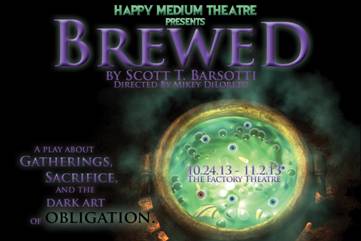
"Brewed" by Scott T. Barsotti Brewed by Scott T. Barsotti enjoyed an opening night performance of The Factory Theatre in Boston on October 24, 2013. The underlying theme conveyed by the endless stirring of a large pot, was the catalyst that created the chaos impetrative to a family of five sisters. "Stirring the pot" generally a metaphor to fan the flames of trouble was used throughout the 95 minute, two act performance. Yet, when the pot was not being stirred, escalated turmoil ensued. The story was based on five sisters who certainly knew how to put the "fun" in dysfunctional. Their frustrations levels became so acute their only resolution was animalistic altercations. With physical challenges of street fighting, they clearly appeared to enjoy the violence confrontations in the hopes of being declared the winner, despite some very graphic appearing injuries. Kudos should be mentioned for realistic bruises and wounds by the special effect make-up artists. The small theatre presented a bare bones set. The industrial brink wall, backed a wooden chair and an ominous looking cauldron, provided the eerie environment of an eerie tale of a tremendously disturbed family. The play opened with Audrey Lynn Sylvia as Paulette, stirring a large pot and uttering the first word of the play, which immediately put an "R" rating on the production. Sylvia's portrayal of the middle sister was angst ridden. She acted her part with accuracy and anger, displaying a touch of tenderness by the end of the play. More interesting roles were sisters Nannette and Collette, played by Lindsay Eagle and Kendall Aiguier, respectively. Eagle was menacing and authoritative as oldest sister and NASCAR driver. Aiguier was feisty and bubbly as the youngest sister. Her role added a bit of comedic light. Second older sister was portrayed by Kiki Samko. As Juliette, her lilting voice provided genteel comfort to handicapped sister Babette, played by Lauren Foster. In contrast, her altercations with some of her other siblings conveyed strength, and anger, undoubtedly an indication of the built up frustrations of being the sole caregiver to Babette. Lauren Foster as Babette was the focus of the sisters after a horrific accident. She took this as a way to milk attention by demonstrating behaviors that far exceeded the components of Post Traumatic Stress Disorder. Her ability to manipulate her sisters with her constant needs, displayed with psychotic outbursts, childlike hyperactivity or infantile cooing, playing on each sisters nurturing abilities and guilt. It wasn't until the end of the first act, when the depths of Babette's manipulation came to a frightening fruition. Sister Roxette was played by Kaitee Treadway. While pieces of her performance were interesting, there were other parts that were disturbing. Conveying love for her sister, while at the same demonstrating an intense pantomimed hatred, she conveyed anger and glee with manic abandonment, which was believable yet creepy. Lee was played by Elizabeth Battey. Familiar with her work from the summer production of Psycho Beach Party, I saw little dramatic range between the characters form both shows. Her lines were delivered quickly and softly. In fairness to Battey, her roles from both productions were similar in nature, so perhaps it was just the similarity of characterization of both scripts. I would really like to see her undertake another kind of role, in order to provide her with an accurate assessment. The play created curiosity. There were so many layers; not only from each character, but the untraditional family dynamics, and that kept the story moving forward the audience at rapt attention. Although the actors bows were tepid, the lingering questions roused were probably foremost in the minds of the audience. Was this real or witchery? Sometimes leaving the audience wondering is the best way to end a show. The show contains strong language and violence. Directed by Mike DiLoreto, "Brewed," by Scott T. Barsotti is at the Factory Theatre, 791 Tremont Street, Boston, MA through November 2nd. For additional Information: mikey@happymediumtheatre.com (My Grade: 3) "La Cage aux Folles" at the North Shore Music Theatre I was eagerly anticipating opening night performance of La Cage aux Folles at the North Shore Music Theatre on September 25, 2013. As a musical theater devotee, I was particularly looking forward to seeing something new to add to my repertoire of musicals. The draw of former Days of Our Life soap star Charles Shaughnessy was definitely appealing as I am a former DOOL addict, and fan of his role as Mr. Sheffield in The Nanny. La Cage aux Folles is a nightclub in France that featured transvestites as the performers. The story centers on club-owner Georges, and his partner Albin, aka ZaZa facing the dilemma of hiding their flamboyant lifestyle from the bigoted father of their son's fiancé. Living right over the club, produces a predicament that involves more than keeping only their personal relationship clandestine. Shaughnessy, as Georges, made his initial appearance at the opening of the show, clad in a tuxedo and looking as elegant as ever. An adequate vocal performer, and exuding charm, it was a delight to watch him as the master of ceremonies, partner, father, and friend to the performers. Georges' partner Albin, was played superbly by Jonathan Hammond. Whether vocalizing as Albin or his alter ego ZaZa, Hammond never faltered in his characterization of a lifelong transvestite whether in full regalia during the evening shows, his neighborhood strolls with Georges, or his attempts to behave like John Wayne, albeit just for 21 hours. With humor and pathos, Hammond and Shaughnessy were a compatible duo. A combination of men and woman comprised the chorus of transvestites. Some of them were so gorgeous, it was impossible to guess if they were singing soprano or falsetto. The costumes were a dramatic blend of black and white geometrics to jewel colored dresses. The dancing was nothing short of fantastic with a combination of tap, ballet, and chorus girl kicks that rivaled the Texas Cowboy Cheerleaders. Each dance consisted of amazingly high energy, and appeared aerobically challenging, yet the dancers performed with seemingly effortless energy creating performances that were breathtakingly spectacular. The role of Jacqueline was beautifully and accurately performed by Paula Leggett, with infectious energy and rich vocals. Another secondary role was played by Maureen Brennan, as Madame Dindon who displayed a glorious soprano vocals. Monsieur Dindon was played by Larry Cahn. His versatility in playing a very uptight conservative politician was perfection in contrast to his final moments forced to participate at La Cage aux Folles in a magnificently sequined cape and head piece. His hilarious expressions and mannerisms were priceless. Zach Trimmer played Jean-Michel, who was raised by his biological father Georges and partner Albin. Accepting of his parent's flamboyant activities, Trimmer was accurate in balancing his parental love with his desire to move on and have a life of his own with fiancée Anne, played by Stephanie Martignetti. Each minute of the show was filled with laughter, awe, or pathos. There was not a moment that lagged. Reactions from the audience varied from laughter, gasps of delight, and genuine sympathy as Albin lamented and defended his life choice in I Am What I Am. By the time the cast reprised the joyful The Best of Times, the audience was singing along. La Cage aux Folles is not for children due to the theme of the show, and some risqué jokes. However, it should be a must see for everyone else, not just for the entertainment, but for the message it demonstrates of being yourself, and having allegiance to your family regardless of controversial lifestyles. La Cage aux Folles will be running until Sunday, October 5. Directed by Charles Repole, and choreographed by Michael Lichtefeld, "La Cage aux Folle," based on the play by Jean Poiret, with book by Jerry Herman and lyrics by Harvey Fierstein, is at the North Shore Music Theatre, 62 Dunham Rd Beverly, MA 01915 through June 23 Tickets $45 - $75. Information: (978) 232-7200 or visit www.nsmt.org (My Grade: 5)
I attended opening night of the Huntington Theatre Company production of The Jungle Book. My 15 year old daughter accompanied me. I though it was important to hear the opinion from someone who grew up watching the Disney version compared to what is being advertised as a ravishing new musical. Performed at the Boston University Theatre, the facility felt somewhat crowded, and lacked the stadium seating for easier viewing. The curtain was graciously late, in consideration of the huge amount of Red Sox traffic. But from the initial opening of the curtain opening, the theatre was miraculously transformed into a huge exotic space as we were treated to a glorious array of floral scenery, representing a tropical forest, with layers of colors from floor and stretching up to the rafters. The transformation of a small theatre was remarkable, as the brightly painted stage and bold canvases most definitely created a jungle environment. Although the actors were not in facial masks or clad in the animal skins of Baloo the Bear, Bagheera the Leopard, Elephant Colonial Hathi or Shere Khan the Tiger, their costumes were indicative of their characters. Bright and colorful, each provided a suggestion of the cartoon character, with secondary characteristics such an orange tiger striped jacket, or elephant ears attached to soldier hats. The cast did not wear special effects make-up for their roles, which allowed identifiable expressions and clearly genuine interactions with the other characters. The ensemble cast and dancers were spectacular clad in brightly colored garb of rich fabrics. As the show progressed, brass, woodwind and stringed instruments were brought on stage by costumed musicians. Adding the accompaniment to the forefront of the show along with the breathtaking panorama, could only be described as a magnificent party on the stage. The cast offered impressive resumes, and their performances were both professional and joyous. Playing the part of Mowgli was 10 year old Akash Chopra. Clad only in a loincloth and wig, the diminutive Chopra was amazing mature with the dialogue, songs and barefooted dancing. Perfect for the part in appearance, he played Mowgli with flawless innocence and spunk. The much loved, Baloo the Bear was played by Kevin Carolan. Physically suited to the part, Carolan had the cuddly appearance of a teddy bear and brought Baloo to life with a cool, laid back attitude contrasting with the caring strength of the "Papa Bear". Andre De Shield, as King Louis added a jazzy, New Orleans feel to "I Wanna Be Like You." With his flamboyant costume and dreadlocked wig, he gave a new twist to the song as well as King Louis, and it worked remarkably well. Larry Yando as Shere Khan the Tiger and nemesis to Mowgli, played his role with a smooth, quiet malevolence while stalking his young prey. His sound performance and transition from an evil hunter to a gentle teacher could only be described as captivating each time he appeared on stage. Usman Ally, as Bagheera, was a gentle panther and less impatience than the Disney version. As an ally to Baloo, with genuine concern for the young man cub, Ally easily was the bonding element during the adversarial meetings of hunter, prey, and protector. Providing a tango-esque twist on "That's What Friend's Are For", was a truly entertaining offering by the Vultures quartet. Clad in ingenious costumes that appeared a cross between shabby suits and the large carnivorous birds, the group worked together with impeccable timing and aplomb. In general, the performance follows the Disney movie, which is based on the Rudyard Kipling collection of stories. The beloved songs written by Academy Award winners Richard and Robert Sherman are as lively as ever. The Huntington Theatre production produced a freshened-up version by collaborating with Indian artists and utilizing Kipling's original text. The Jungle Book is no longer just an entertaining musical for children, but rather a rich, complex and highly entertaining brilliant event. With these additions and adaptations, the original theme was rich and sophisticated, evoking the proclamation form my 15 year old that The Huntington Theatre production of The Jungle Book was one of the best plays she's seen recently. The Jungle Book will be running until Sunday, October 20th. Due to popular demand, this show has already been extended. Directed by Mary Zimmerman and Christopher Gattelli, "The Jungle Book," based on the Disney Animated Film and the stories of Rudyard Kipling is at the Boston University Theatre, 264 Huntington Avenue, Boston, MA 02115 through October 20. Tickets $25 - $135. Information: (617) 266-0800 or visit huntingtontheatre.org. (My Grade: 5)
"CATS" at the North Shore Music Theatre The popular Andrew Lloyd Webber melodies accompanied the writings of Old Possum's Book of Practical Cats by T.S. Eliot in North Shore Music Theatre's opening night performance of CATS on August 21, 2013. 
"Psycho Beach Party" by Charles Busch Psycho Beach Party by Charles Busch enjoyed an opening night performance of The Factory Theatre in Boston on July 25, 2013. "The Wizard of Oz" at the North Shore Music Theatre The much beloved musical, The Wizard of Oz enjoyed its opening night performance at the North Shore Music Theatre on July 18, 2013. This fantasy filled production did not disappoint. Never missing the yearly televised airing, The Wizard of Oz was my favorite movie, and at 14, I was thrilled to play Glinda, the Good Witch in a camp performance. I knew every word of the movie, every inflection to each line and every note to each song. However, the opening night of The Wizard of Oz was an original and contemporary version of the 1939 version. The young actors provided their own personal flavor to their characters…and it worked wonderfully well. Even as a passionate Oz enthusiast, I enjoyed the unique interpretation of each character. Supergravity and the Eleventh Dimension Supergravity and the Eleventh Dimension by playwright Heather Houston performed by the Vagabond Theatre Group enjoyed an opening night performance of The Factory Theatre in Boston on July 11, 2013. "The Sound of Music" at the North Shore Music Theatre The memoirs of Maria von Trapp were beautifully performed at the opening night performance of The Sound of Music at the North Shore Music Theatre on June 12, 2013. Featuring a selection of music by Richard Rodgers and lyrics by Oscar Hammerstein II, I had been listening to the original 1959 recording featuring Mary Martin (mother of the late Larry Hagman) ever since I was old enough to place a 33 1/3 LP on the turntable, memorizing each song without missing a word. Admittedly, I had trepidations of the redundancy of attending a performance of The Sound of Music. But opening nights at the NSMT was like a breath of mountain air. The stellar cast and the simplicity of the theatre-in-the-round with clean minimalism of the scenery made for a performance that provided a fresh nuance at every turn. The story focuses on Maria Rainer, a high-spirited postulant who leaves the convent to be the governess of a seven motherless children. With her exuberance and love of music, she introduces the children to a more carefree way of life, eventually softening their father who ultimately falls in love with Maria. They marry just prior to the Nazis annex to Austria in 1938. Unwilling to support the third Reich, the family escapes over the mountains to Switzerland The show began at the Nonnberg Abbey in Austria with the nuns chanting the Latin Preluduem, a Capella and with harmonious precision. This short introductory scene was immediately by followed by Maria singing in the mountains near the Abbey. Her version of "The Sound of Music" was a tad slow and didn't give her the opportunity to reflect the carefree nature of Maria. However, by the time she was preparing for her journey to the von Trapp household, her performance of "I Have Confidence" did in fact display the youthful enthusiasm expected of Maria. Maria was played by Londoner Lisa O'Hare, a waiflike, delicate beauty with a clear soprano to rival Julie Andrew's performance in the movie version. A perfect partner both physically and vocally was David Andrew McDonald, who played Captain Georg von Trapp, whose rich baritone conveyed strength as well as softness. The musical numbers and interactions with O'Hare provided an attractive duet as they complimented each other so perfectly. The children were an endearing blend of local and national actors. Standing out was Deirdre Haren playing Liesl von Trapp, the oldest daughter. Haren's beautiful vocals and national experience provided a seamless bond that kept the younger actors in a finely tuned, cohesive group. The children, all trained actors, did not allow their professional background to take away from the happy-go-lucky children they were playing. Even tiny Gretl, played by 5 year old Paige Catherine Martino who was enjoying her theatrical debut, was as poised and proficient as her onstage siblings. The children were undoubtedly adorable while singing the uncomplicated "Do Re Mi", but it was their version of "The Sound of Music" that displayed a blend of solid talent and provided a moment that was both touching and tearful. Actress Jacquelynne Fontaine as Baroness Elsa Schrader was confident, sultry, likeable and a wonderful contrast to the cool blond Eleanor Parker in the movie version. Included from the original soundtrack were the amusing tongue-in-cheek "How Can Love Survive" and "No Way To Stop It", performed impeccably by Fontaine and James Beaman, as Max Detweiller, a mutual friend of the Captain and the Baroness who is searching for a new musical act to compete into the upcoming Salzburg Festival. I was a bit disappointed at the blocking of the dance scene where the first hint of romantic sparks occurred between Maria and Captain von Trapp. The accompanying dancers interfered with the view of the couple at center stage at three different points. Perhaps if the dancers had circled the stage instead of remaining stationary, this important moment would not have been hidden to some of the audience. When a confused Maria returns to the Abbey and confesses her feelings toward Captain von Trapp, Suzanne Ishee as Mother Abbess, encourages her to search for her destiny in a stunning rendition of "Cimb Every Mountain", arguably the most melodious, yet powerful ballad of the show. With grand soprano vocals, her interpretation was magnificent. As the intermission lights came on, many of the audience members were wiping away tears, evoked by the truly emotional performance. This was easily the highlight of the show. With a slight adaptation by the inclusion of two songs from the 1965 film version "I Have Confidence" and "Something Good," composed by Rogers after Hammerstein's death, the movie-version aficionados were also treated to the lesser known songs from the 1959 score. Although the music and characters were well known, the interpretation and actors managed to keep the performance exciting and bright, with a sense of newness in a musical that had been popular for over 50 years. The Sound of Music will be running until Sunday, June 23. Due to popular demand, this show has already been extended. (My grade: 5) Directed by James Brennan and Dale Rieling, "The Sound of Music," by Richard Rodgers, Oscar Hammerstein II, Howard Lindsay and Russel Crouse, suggested by "The Story of the Trapp Family Singers," by Maria Augusta Trapp, is at the North Shore Music Theatre, 62 Dunham Rd Beverly, MA 01915 through June 23 Tickets $45 - $75. Information: (978) 232-7200 or visit www.nsmt.org Ching-Lish Just concluded at The Lyric Stage Company of Boston was their production of "Ching-Lish" by David Henry Hwang, an area premiere. Set in contemporary China, Daniel Cavanaugh (Barlow Adamson), unhappily married, hoping to resuscitate his losing business prospects, has come to China expecting to revive his commercial opportunities. He counts on promoting new, prominent urban signs for the city of Guiyang. When he meets Xi Yan, (Celeste Olivia), a prominent vice minister, he quickly recognizes her as his prime goal. Obviously, she has all the necessary connections and should be able to get all the best contracts. Initially, cold and austere, she soon sees him as enterprising and begins to warm up to him, with unexpected onsequences. Added to this odd mixture is Peter Timms (Alexander Platt), a longtime British expatriate, fluid in Mandarin conversation, and ready for any new and profitable circumstance, who quickly promotes himself as Daniel's business consultant. Unfortunately, all of these buoyant opportunists are ultimately as confused about business in China as it is possible to be. Added to this odd mix is Major Prime Minister Cai Guoliang (Michael Tow), who is Xi Yan's overseer. Regrettable, he's burdened by a highly ambitious (although unseen) wife. Lamentably, none of these contenders is able to achieve the success he had expected. Since virtually all of the Mandarin dialogue is spoken in Mandarin, a large, centrally elevated screen is suspended high above and behind the play's actors and actresses. Unfortunately, all of the English translations appear as light blue lettering against the screen's dark blue background, making some of it difficult to read. If the translations had been in white, against the dark backing, certainly much of the above mentioned difficulty would not have occurred. Otherwise, commendations are certainly due for Dahlia Al-Habaiell's massive setting, Matthew Whiton's lighting, Emily Hogue's costumes, and of course Larry Coen's well focused direction. (My grade: 4) The Christmas Revels Now at Sanders Theatre in Memorial Hall on the campus of Harvard University in Cambridge, Mass., is the 42nd annual production of "The Christmas Revels." This year, their latest presentation is entitled, "An Irish Celebration of the Winter Solstice," and as its title says it is indeed a very festive Celtic offering. The play is set on the front two level deck of a sea-going Cunard ocean liner that is ready to cross the Atlantic Ocean, bound for America. It's the beginning of the 20th century, with a host of Irish emigrants aboard looking forward to their new life in the United States. As expected, their voyage will be filled with grand singing and exuberant dancing. As these travelers begin boarding the ship they start lustily singing a joyful, traditional Irish tune called, "The Wexford Carol," accompanied by the impressive Cambridge Symphonic Brass Ensemblists, that is followed by a chorus of small children chanting "there's a big ship sailing," succeeded by Julia McSweeney on fiddle and Isabel Siu-Zmuidzinas step-dancing! Later, songstress Mary Casey joyfully sings the traditional musical salute to the homeland's "Little Skillet Pot" accompanied by the lusty "Wild Geese Chorus!" Especially impressive Billy Meleady as a lively "Poet in Exile," then introduced "The Lobster Quadrille" danced by a group of eight, costumed as crimson lobsters. Billy was then accompanied by Steven Barkhimer, dressed as a pirate, journeying to the bottom of the sea! Then, the ever-impressive David Coffin, along with the stirring "Wild Geese Step Dancers," with harp, violin, flute, banjo, accordion and drum accompaniment, joyfully saluted "The Rocky Road to Dublin." Amongst the evening's high points were the vivid "O'shea-Chaplin Academy Irish Dancers," certainly one of the show's best! Still later, the full capacity audience was encouraged to enjoy a brief intermission guided by David Coffin, again, singing the show's traditional "Lord of The Dance." The evening's splendid second part was strikingly defined by Mary Casey's plaintive singing of "The Wexford Lullaby," and Billy Meleady's tender recitation of St. Patrick's "Lorica" Prayer. Soon thereafter, an instrumental collection framed by a group of reels were brightly enhanced by the playing of a bagpipe, followed by even more step dancing! Then came, "Hunting The Tiny Wren," a small bird whose sacrifice was related to the Celtic sacrifice of the old "yearking" rousingly sung and danced! Next came the vigorously combating "White Star Rhymers' Play," performed from head-to-toe in large box-like straw costumes, framed by "The Young Blades," battling with one another, with long wooden rods! Narrated again by Meleady and Barkhimer with Ronald Nath as Father Christmas. Then came "Hymn for New Land," based on Psalm 118, rousingly performed by the chorus and the Cambridge Symphonic Brass Ensemble. Later this grand song-and -dance fest came to its stirring conclusion with the revels traditional rendition of "The Sussex Mummer" carol. This grand full family holiday treat is now playing through December 30, 2012. (My grade: 5) The Nutcracker Once again at the Boston Opera House The Boston Ballet stages its grand yule-time presentation of Tchaikovsky's "The Nutcracker." Now redesigned with new majestically lush yet softly hued pastel settings and costumes by Robert Perdziola, framing Mikko Nissine's splendidly reconsidered choreography and strong leadership. Again, it's Christmas Eve in a small town in Germany in the 1820's, as very youthful Clara (Eliza French) merrily observes the festivities with her brother, friends and family. Soon, their favorite uncle: Herr Drosselmeier (Lasha Khozashvilli) comes with gifts for everyone. With everybody celebrating, the family's large pet bear (Irlan Silva) gambols about happily. Uncle Drosselmeier has also come with two big dancing dolls: a ballerina (Sylvia Deaton) and harlequin (Patrick Yocum). He's also bringing a brightly vivid toy nutcracker as a present for Clara. Late that evening, when everyone else is asleep, Clara comes back to frolic with her new plaything. However ,suddenly a large bevy of house mice appear with a jumbo rodent (Paul Craig) as their King. At the same time, the family's brightly adorned yuletide tree suddenly extends upward to grander height! Similarly, Clara's colorfully small plaything turns into a robust, full-sized, handsome prince (Paulo Arrais). Then accompanied by her, they all come together to fly upwards to be greeted, in the Nutcracker Prince's kingdom, by the realm's majestic snow queen and king. There, they are all fascinated by a host of grandly exotic performers. First, they're all delighted by a group of animated by Spanish dancers (Alison Basford, Brittany Summer ,Dao Yuen Chen and Christopher Warhuus). Next they're joined by a duo of sensuously mobile Arabian dancers (Kimberly Uphoff and Sabi Varga) followed by a twosome (Slyvia Deaton and Isaac Akiba) of picturesque Chinese dancers performing in front of a big assembly of bright and colorful hand-held rotating umbrellas! Then cam a lithe and lovely pastorale trio (Lawrence Rines, Ekaterine Chubindze and Corina Gill) succeeded by an expansively costumed Mother Ginger (Isaac Akiba) housing a large assembly of cavorting children under mother's super large skirt! They were then followed by a high leaping trio of jumping Russian dancers (Avetik Karapetyan, Irlan Silya and Altan Dugaraa) whose antics raised the cheering capacity audience out of their seats! Next was the sensual "Waltz of the Flowers," accompanied by the enthralling dew drop (Dusty Button). All of this gloriously concluded by the grand pas-de-deux dance by the handsome Prince and the lovely sugar plum fairy (Ashley Ellis). Clara, her stately prince and jovial uncle then joyfully return home. This genuinely captivating , and newly redesigned presentation was splendidly enhanced by the company's grand full orchestra conducted by Genevieve LeClair. Now playing through December 30, 2012. (My grade: 5) BETRAYAL Now at the Boston University Theatre, The Huntington Theatre Company presents its new production of "Betrayal" by Harold Pinter. First staged in 1978, this short 90 minute one act drama, is considered by many to be the playwright's most strikingly innovative. Unfolding in reverse, the plot centers on husband Robert (Mark H. Dold) and his wife Emma (Gretchen Egolf) and their married friend Jerry (Alan Cox). Beginning as Emma's marriage to Robert is ending, their seven year extra-marital affair is now dissolving. Surprisingly, even at its midpoint, when husband Robert discovers his wife and best friend's deceitfulness, his response is to then begin his own state of adultery. Their saga unreels, as stated from finale to onset, with his trio at the finale, as haunted and torn players, rewinding from their layers of infidelity, lies, and deceit to their original ill-considered gambol. Strikingly staged as a succession of spare and simple vignettes designed by Allen Moyer, heightened by Philip S. Rosenberg's simple lighting and enhanced by John Gromada's strong lighting, the play's innovative reverse-to-beginning progression is potently redefined at its finale (Emma and Jerry's initial encounter) by the evening's only fully developed interior living-space setting. Bravos are also due for Maria Aitken's strong direction. Now playing through December 9, 2012. (My Grade: 5) THE PIANIST OF WILLESDEN LANE Now at the Jackie Liebergott Black Box Theater in the Boston Paramount Center is "The Pianist of Willesden Lane" by Mona Golabeck and Lee Cohen, based on the book "The Children of Willesden Lane", adapted and directed by Hershey Felder. Seated alone at a grand piano, before a splendid drapery adorned by a quartet of pictorially projected notables featured on otherwise blank picture frames, Mona Golabek plays and recounts the story of her late mother Lisa Jura, a child prodigy and promising performer. A talented pianist, as a young Jewish maiden in 1938 Austria, she was forced to flee the impending Nazi onslaught. This is the story of the new life Lisa developed with determined self-reliance, unyielding expectation, and tenacious resilience. It follows young Lisa via the legendary "Kinder Transport" from Vienna into Holland and then by ship to Liverpool. Once in England she was finally able to find her cousin, but his inability to provide a haven for her forced her to look elsewhere. Later in Bloomsbury, laboring as a seamstress by day and quietly playing on their piano at night, she ultimately leaves and finds her way to Northern London and Willesden. There, she lives through the ever repeating "London Blitz," while continuing to practice at a basement piano at night while sewing tapestries by day. As a young woman, eventually she applies for a scholarship to London's Royal Academy of Music. Her success there is crowned by her triumphant performance of Grieg's Piano Concerto! Lisa Jura's uplifting story is enhanced throughout by daughter Mona Golabek's stirring renditions on the aforementioned grand piano. Her mother's provocative story is enhanced from start to finish by daughter Mona's splendidly strong piano performances. The well-known strains of Beethoven, Chopin and Scriabin, amongst others, resound gloriously throughout. Now until December 6, 2012. (My Grade: 5) THE CHOSEN Now the Lyric Stage Company of Boston presents its new production of "The Chosen," adapted by Aaron Posner and Chaim Potok from Potok's 1967 novel. It was also produced in 1981 as a major Hollywood motion picture and later briefly also as a musical play. Set during World War II, it centers on the unlikely friendship of two young Jewish boys, Reuven (Zachary Eisenstat) and Danny (Luke Murtha). Set in Williamsburg and Brooklyn, New York, they meet as opposing members of a local softball fame. While Reuben is a typically average neighborhood teenager, his friend Danny, with his large brimmed black hat, black outer garments and long straddling side-hair curls, is quickly identified as a "chasid." They are members of the distinctly separate, devoutly religious, noteworthy and readily recognizable Jewish sect. Reuven quickly learns that his new friend Danny is being groomed by his elderly, authoritative father Reb Saunders(Joel Colodner), the sect's grand Rabbi, to later assume the sect's leadership, when he becomes the appropriate age. The relationship between these two distinctly different teenagers is introduced and commented on throughout by the later adult Reuben (Charles Linshaw). Unexpected changes in the rapport between these two young friends begins to develop as World War II comes to an end. Reuven's father David Malter (Will McGarrahan) is a fervent Zionist and as such sees the ending of World War II as the opportunity to for the remnants of the war ravaged Jews to finally return to Palestine and to then establish their new homeland and state of Israel. Of course, this would be brought about primarily by political means, rather than by the divine intervention that Danny's ultra-orthodox and authoritative father Reb Saunders prays for and ultimately expects. Even though this might have created a schism in the friendship between Danny and Reuben, no such split occurred. In fact, even though each would make dramatically different lifestyle choices as they grew into adulthood, their friendship would continue to remain strong. This grandly compelling and provocative coming-of-age drama is now playing through November 17, 2012. (My Grade: 5) BENGAL TIGER AT THE BAGHDAD ZOO Now at The Boston Center for The Arts is the area's premiere of "Bengal Tiger At The Baghdad Zoo" by Rajiv Joseph. A recent success on Broadway, this existentialist drama marked the stage return of Robin Williams in the title role. This 2010 Pulitzer finalist is a presentation of Company One and is being vividly directed here by Shawn LaCount, the company's artistic leader. Two American G.I.'s, Tom (Ray Ramirez) and Kev (Michael Knowlton) stand guard to the left and right of the giant padlocked gate of the city's great war-torn zoo. It's only inhabitant is the title's grand Bengal Tiger (Rick Park), who is dressed in average, regional clothing. Unfortunately, after soldier Tom's hand is torn of by the imprisoned beast, when he foolishly pokes it into its cage, his partner Kev shoots and kills the tiger! However, the angry animal's ghost remains, to question the spirits about his purpose, in the grand scheme, as a predator. Still later, soldier Kev is hospitalized after "freaking-out" upon seeing the spectral beast, as he's on a search and destroy outing! Also involved in these ghostly upheavals are Uday Hussein (Mason Sand), the malevolent son of the deposed dictator and Musa (Michael Dwan Singh) his former gardner. Like the others, Uday's phantom returns to harass Musa, who's now helping the American's as well as his sister Hadia (Hallie Friedman). Throughout, this strife-ravaged center is dominated by the specters of its past, whose restless unease and disquiet serve as the ongoing consequences of war and its aftermath. Commendations are most certainly due for Dahliaal-Habieli's effective setting, Lara DBruij's costumes and Jen Rock's dramatic lighting. Now playing through November 17, 2012. (My grade: 5) BLOOD BLOODY ANDREW JACKSON Now at The Calderwood Pavilion in the Boston Center for the Arts, the Speakeasy Stage Company presents the area performance of "Bloody Bloody Andrew Jackson," with book by Alex Timbers and music and lyrics by Michael Friedman. It's being performed mostly in contemporary dress, complete with microphones, full amplification and a raucous, roaring rock bank. It tracks the grand rise of our seventh president from his early years as a back woods pioneer to his battle successes and his ultimate political accomplishments. As the onstage narrator (Mary Callahan) begins his story, we follow Andrew Jackson (Gus Curry) from the War of 1812 and his subsequent defeat of the Creek Indians, to his triumph at the Battle of New Orleans and still later his victory against the Spanish in Florida. These accomplishments are also buttressed by such personal good fortune marked by his romance and marriage to Rachel Robards (Alessandra Vaganek). His ascent is framed by his tribulations (both pro and con) with political luminaries such as John Calhoun (Ryan Halsaver), John Quincy Adams (Tom Hamlett), Martin Van Buren (Joshua Pemberton) and James Monroe (Ben Rosenblatt). Amongst the great controversies during his presidency was the enforced March of the Cherokee Indians known as "The Trail of Tears," which resulted in so many thousands dead! Commendations are also due for the aforementioned music direction by Nicholas James Connell as well as the choreography by Larry Sousa. Of course, high marks must go to Director Paul Melone as well. This contemporary tinged exploration of one of our most storied and historically controversial leaders is now playing through November 17, 2012. It is highly recommended! (My Grade: 5) The MotherF----- With The Hat Now at The Speakeasy Stage in the Boston Center for the Arts is their production of "The MotherF..... With The Hat" by Stephen Adly Guirgis. This presentation represents the area premiere of this 2011 Tony Award nominee for Best Play. Now on parole, after being imprisoned for drug-dealing, recovering alcoholic Jackie (Jaime Carrillo) returns to his girlfriend Veronica's (Evelyn Howe's) apartment. He's trying his best to start anew by regularly conferring with his sponsor Ralph D. (Maurice Emanuel Parent) and attempting to follow his advice. Since Jackie now holds a legitimate job, he's come to reunite with Veronica. Unfortunately, she's still very addicted to "coke" and is uninterested in breaking the habit. Now eager to make love to her, Jackie notices a man's felt hat on a nearby soft chair. He's immediately convinced that Veronica's been unfaithful. Unable to definitely prove his suspicions about a neighbor he turns to Ralph D. who suggests yoga. Still unsatisfied, Jackie visits his cousin Julio (Alejandro Simoes), who although seemingly fussy and fragile, is immediately ready to assert himself to help Jackie. Also quite involved in this mix is Victoria (Melinda Lopez), who's long suffered years of disappointment as the wife of Ralph D. She realizes that he has been regularly cheating with Veronica! Ultimately, when Jackie finally begins to realize the reality of those around him, he knows that he must make some difficult decisions about his future. This well-written and performed play focused on the ever-demanding plight of a conflicted recovering drug and alcohol abuser and his ongoing and unrequited love for his determinedly self destructive sweetheart, certainly deserves all the accolades it has already received. Now playing through October 13, 2012. (My Grade: 5) The Mikado Now at the Lyric Stage in Boston is their new production of Gilbert and Sullivan's "The Mikado." This legendary favorite arrives in a sparkling production, still faithful to the originators, but now cleverly accented with many amusing current topical and popular references added. Of course, all of the expected and fanciful characters appear on stage. "Nanki-poo" (Davron S. Monroe), the grandly resonant son of the show's titled potentate, now disguised as a wandering minstrel, "Ko-ko" (Spiro Veloudos - unexpected replacement for the ailing Bob Jolly) who is the play's town of Titipu's Lord High Executioner, "Yum-Yum" (Erica Spyres) a ward of the aforementioned "High Executioner," and in love with "Nanki-Poo," "Poo-Bah," (David Karvitz) who's the "Lord High of Everything Else," "Phis-Tush" (Rishi Basu) a noble Lord, "Pitti-Sing" (Teresa Winner Blume), and "Peep-Bo" (Stephanie Granade) both sisters of "Yum-Yum" and "Katisha" (Leigh Barrett). the show's highly sonorous local shrew, who ultimately winds up with "Ko-Ko," plus of course the play's predominantly relied upon "Mikado" (Timothy John Smith)! As noted, this delightful presentation also regularly integrates many cleverly comic and noteworthy names and hints to the show's merriment such as Romney's "47 Percent," "The Evening's Titled Potentate" as "The Antonin Scalia" of the day, and even "Ko-ko's" little list referring to an audience member as being one "who would not ever be missed." Certainly Janie Howland's serene Japanese styled traditional setting, Jonathon Goldberg's lively orchestral accompaniment, Rafael Jaen's lovely prescribed costumes and most certainly the aforementioned Spiro Veloudos who also strikingly staged and vividly directed this splendid production are all most worthy of high praise! Now playing through October 13, 2012. (My Grade: 5) Lumberjack In Love Now recently concluded at Stoneham Theatre in Stoneham, Mass. is the area premier of "Lumberjack In Love," featuring music by James Kaplan wiht book and lyrics by Fred Alley based upon their own original story. It's quite a popluar favorite in Wisconsin where its been frequently performed since its debut there at "The American Folklore Theater" since 1994. Set deep in Northern Wisconsin, in the late 1870's, at the Haywire Lumber Camp. There four, rough and burly loggers living together in their wild, unfettered and natural workplace. Their day has begun after a raucous late night of whiskey laced frivolity! "Muskrat" (Steven Barkhimer), who's usually content and confident, now seems anxious as his 40th birthday draws near. "Minnesota Slim," (Mark Linehan) who's usually flustered and confused about females, has surprisingly assisted "Dirty Bob" (William Gardiner) into connecting with a potential mail-order bride, while "Moonlight" (Harry McEnerny) remains as confused and unknowing as ever. As his name asserts, "Dirty Bob" hasn't bathed in quite a long while. Also, an outsider known as "The Kid" (Darcie Champagne), who joins this lively group often, is actually an attractive female disguised as a young man. As such, she's quietly feeling strongly attracted romantically to "Moonlight!" Soon thereafter, to everyone's surprise, "Rose" (Vanessa J. Schukis), the pre-ordered-by-mail, potential wife, arrives turning the aforesaid Lumberjack's lifestyle upside down! Eventually, when the group's bewilderment and shock turns finally to calm and acceptance, "The Kid" feels confident enough to reveal her true identity. By so doing, Rose also feels emboldened enough to assure the soon-to-be refreshed "Dirty Bob" of his bright and potentially happy future. As expected, his fellow loggers concur. From start-to-ending all six cast members follow their play's simple story by listily singing the evening's lively songs while accompanying themselves on a wide variety of hand-held musical instrument ranging from bass, accordian, mandolin, percussion, pennywhistle and ukelele to concertine, trombone, guitar, sax and fiddle, amongst even others. "Shanty Boys," "Winds of Morning," "LIttle Black Raincloud," "Rub-a-Dub-Dub," 'Bachelor's Prayer," "Stupid, Stupid Love," and the play's title song are just a sampling of the evening's many tunes. While these agreeable folk and bluegrass-like melodies are pleasant enough the show's overly simplistic plot remains much too uninvolving. Certainly Steven Barkhimer as both a leading actor and the show's music director was noteworthy, while Erik Diaz's highly adaptable rustic woodland hut setting also served the play very well. Similar commendations must also go to the Director Caitlin Lowans. (My grade: 3.5) The Kite Runner Now recently concluded at the Mosesian Theater in residence at the Arsenal Theater Center for the Arts in Watertown, Mass., the New Repertory Theatre presents their production of "The Kite Runner," adapted by Matthew Spangler, based on the novel by Khaled Hosseini. The play's focus centers on childhood friendship between two young boys, beginning in their native Afghanistan in the mid-1970's Youthful Amir (Fahim Hamid) is the son of Baba rich "Pashtun" businessman (Ken Baltin). Hassan (Luke Murtha), a member of the lower social class "Hazaras," is not only Amir's best friend but is in actuality mainly his servant, too! His father Ali (Johnnie McQuarley) is likewise Amir's father Baba's servant, too. Amir, as adult (Nael Nacer) serves as the play's narrator throughout. The young Amir and Hassan altogether as partners, when it comes to their hometown Kabul's favorite activity - - kite flying! When such popular matches are initiated, Amir flies his kite while Hassan retrieves it for him after it comes down. However their bond is unexpectedly altered when another young ruffian (John Zdrojeski) and his pals beat and sexually violate Hassan, while Amir, hiding nearby, watches silently and doesn't intervene. Later, now with their friendship disrupted, Amir tries to convince his father to terminate both Hassan and his father. But before he's able to sway his parent, both the younger and elder servants leave of their own accord. Still later, when political upheaval begins to erupt and Afghanistan's social order starts to be overturned, Amir and his father hurriedly also decide to leave their country. Years later, the adult Amir and his elderly father are living in the San Francisco Bay area. As time passes, eventually the elderly Baba is stricken with and dies from cancer. Still later Amir meets and ultimately marries Soraya (Paige Clark), also an Afghan refugee. Soon, however, they discover that Soraya is unable to bear children! Eventually Amir then decides to return to Afghanistan to possible learn about his old friend and maybe if possible somehow adopt a related child, with surprising and grandly complicated consequences. Vividly acted by the large cast on a relatively spare and neutral setting. Although some of the overly detailed aspects of Amir and Baba's early life together in California might have been more effective if presented in a much less over-explicitly developed way, the story of these two young friends was still quite compelling under Elaine Vaan Hogue's well focused direction. Crimes of the Heart Now, just concluded at the Gloucester Stage in Gloucester, Mass., was their production of "Crimes of The Heart." Written by Beth Henley, it went on to win the 1981 Pulitzer Prize as well as the New York Drama Critics Circle Award as Best American Play. It was also produced as a major Hollywood motion picture in 1986 for which Ms. Henley also adapted the screenplay. Set in the mid-1970's in a small Mississippi community, it centers on the three Magrath sisters. Still dismayed by their mother's suicide, many years ago, sometime after their father deserted them, they were raised by their grandfather, now gravely ill in the hospital. Lenny (Liz Hayes), the eldest, is unmarried and is today marking her 30th birthday alone. She recently ended her relationship with an earnest young man. However she's soon joined by Babe (Melody Madarasz), her youngest sister. Married, volatile and reckless, she's just been bailed out of jail for taking a shot at her prominent businessman husband. Before long, they are also greeted by Meg (McCaela Donovan), the middle-aged sister. Now returning from some years in California, recoiling from her failed aspirations for a career as a popular vocalist, she's come back to help her youngest sister. Shortly, their friend Doc Porter (Liam McNeill) shows up for a brief visit. Although now married and a father, his former attraction to Meg is re-ignited! Soon however, she initiates a late night liaison with him. Although she's able to stir his former ardor, his sense of responsibility to his family ultimately counters her ploys. Later, in response to Babe's problem, Barnette Lloyd (Will Keary), a young local lawyer, drops in expecting to be of help. Also, throughout this day, Chick Boyle (Lenni Kmiec), the sisters' smug, overbearing and annoying cousin, shows up briefly and soon leaves only to reappear once again. As always, she's eager to circulate some misfortune, and re-stir misguided old gossip. As the highs and lows of these three very different sisters unfolds over the span of two acts, their combined reminiscences, together with their current problems, ultimately seem to energize them and surprisingly even begin to help them. It also featured a warm and typical kitchen setting designed by Jenna McFarland-Lord, with appropriate costumes by Rachel Padula-Shufelt all well-defined. Commendations were certainly due for Carmel O'Reilly's well focused direction. (My grade: 5) Marie Antoinette Now at the Loeb Drama Center in Cambridge, Mass., The American Repertory Theater in a co-production with the Yale Repertory Theater presents the world premiere of "Marie Antoinette" by David Adjmi. Unfolding in two acts, including a brief intermission, it chronicles the ups and down times of the spirited and ultimately doomed Austrian-born child bride of the squat, short and undistinguished Louis XVI. The first act lays open much of young Marie's insulated lifestyle marked by her inadequate training and tutelage and framed by the notion of divine right. Her waking days are defined by a succession of sky-high bouffant's and highly elaborate parade of fanciful and colorful garments. Surprisingly, the play's dialogue eschews the overly florid talk expected for the times by utilizing contemporary conversation instead. Although Marie is supremely uninformed her denseness is simply a result of her very limited past. She's certainly not the monster that the soon to be revolutionaries expect. Although she does eventually say the much quoted declaration about "cake," so often attributed to her, in this instance it's simply advice to a friendly parent! Similarly, her dumpy and witless husband is virtually just as naive and unenlightened as his young wife is. He's vividly terrified by the surgery necessary for him to impregnate Marie. However, after many years, finally succeeding, she is able to bear him a son. Years later, as the expected armed uprising overtakes them, they all await their fate with the guillotine in a dark and empty prison cell! It's being vividly performed by Brooke Bloom, with fine support by Steven Rattazzi as Louis XVI. High marks are also due for Fred Arsenault as Austrian royalty, Andrew Cekala as Marie's young son, Hannah Cabell, Jo Lampert, Polly Lee and Jake Silberman as nobility and David Greenspan as a fanciful sheep, who is represented in a splendid pastoral setting. Kudos are also due for Gabriel Berry's bright costumes, Ricardo Hernandez' effective settings, Matt Acheson's fine puppetry, and Rebecca Taichman's well-focused direction. Now playing through September 29, 2012. (My grade: 5) ALL SHOOK UP Now at Bill Haney's North Shore Music Theatre in Beverly, Mass. is their new production, (of course "In-The-Round,") of "All Shook Up," a new musical play, with book by Joe DiPietro, celebrating the songs performed by Elvis Presley. It's not a biography of the great star's life but rather a song-laden story of small-town Middle America, set in the mid-1950's, with its focus on the amorous ups-and-downs of its residents and teenagers. Chad (Ryan Overberg), a leather-jacketed, guitar-strumming, motorcycle-riding stranger arrives in town and through the power of his presence affects and inspires the lives of the town folk. Sweet, young Natalie (Dara Hartman), who pumps gas at her dad's filling station, is immediately smitten by this charismatic newcomer. Ungainly Dennis (Paul Sabala), her timid "wanna-be" boyfriend, eventually becomes Chad's sidekick and helper. Of course, the interloper's appearance also upsets the town's hostile Mayor (Joyce Dewitt), who tries her best to thwart Chad's influence. Meanwhile, the newcomer's clout eventually even has its effect on Sandra (Coleen Sexton), the lovely curator of the town's new museum of culture. Even middle-aged Sylvia (Jannie Jones), the African-American owner of the local bar, is invigorated, while Lorraine (Laquet Sharnell), her teenage daughter, falls deeply in love with young, military-school-bound, Dean (Eric Hatch). As expected, their controversial romance angers the Mayor, Dean's wrathful mom! Naturally, all of these overlong, overloaded, overly standard and familiar dilemmas facing the highly effective and transforming newcomers, are all successfully resolved by the show's more than 2½ hours performance time. Certainly the many songs introduced by Elvis afford us the evening's best moments. "Jailhouse Rock," "Heartbreak Hotel," "Teddy Bear," "Hound Dog," "Love Me Tender," and the show's title song, amongst many others, represent the show's best moments. The large, strong voiced and highly spirited cast, do their best with the overly well-known and overlong material. Commendations are also certainly due for Paula Peasley-Ninestein's varied costumes, David Neville's dramatic lighting. The fine, full orchestra conducted by Annie Shuttlesworth and of course Russell Garrett's direction. Now playing through August 26, 2012. (My Grade: 3) MY FAIR LADY Recently concluded, after an all too brief engagement at the Reagle Music Theatre, on the campus of the Waltham High School in Waltham, Mass., was their production of "My Fair Lady." Once again, featuring Alan Jay Lerner's book and lyrics together with Frederick Loewe's beloved music, all combined and quite true and faithful to George Bernard Shaw's classic play, "Pygmalion." However, also included is this adaptation's redefined "Happy Ending," which Shaw's original had so decidedly avoided! Set in pre-World War I London, Henry Higgins (Rick Hilsabeck); a master of phonetics, bets his friend Colonel Pickering (R. Michael Wresinski) that he can change Eliza Doolittle (Sarah Pfisterer) from appearing as a humble cockney flower maid into instead being accepted as a "lady," in prominent society, simply by teaching her to speak correctly. Of course, this would also require much more elegant clothing! Later, after many, many weeks of great effort, the highly autocratic and self-centered bachelor succeeds beyond his own expectations. However Eliza, now fancifully transformed, has a new and better view of herself. As such, she decides to actively change her autocratic mentor into a more sympathetic, and even later, into a genuinely more accepting and loving person! Kudos are certainly due for the large, spirited supporting cast with special mention for Donna Sorbello as Higgin's understanding mother, as well as Eliza's lively working-class dad Alfred P. Doolittle (Harold "Jerry" Walker). Additional notice is also due for the grandly sonorous Robert St. Laurence as Freddy Eynsford-Hill, an occasional and possible sweetheart for the newly redefined Liza. "Wouldn't It Be Loverly?," "With a Little Bit of Luck," "The Rain in Spain," "I Could Have Danced All Night," "On the Street Where You Live," "Get Me to the Church on Time," and "I've Grown Accustomed to Her Face," are just a few of this great show's supremely memorable musical score. Commendation must also go to Rachel Bertone's recreated choreography, and the vivid fine, full orchestra conducted by Jeffrey P. Leonard as well as to Larry Sousa's well focused direction. (My Grade: 5) Billy Elliot - The Musical Now at The Boston Opera House is "Billy Elliot - The Musical," featuring book and lyrics by Lee Hall with music by Elton John and based on the same-titled popular 2000 British Motion Picture. As in the original film, its focus is on the young, pre-teenaged boy whose name is this story's title. Set in Northern England in 1984 during that period's massive miners' strike, it concerns youthful Billy's surprising involvement with a local ballet class and the dramatic changes it brings about for him. Guided by the group's hardened, yet often tender, chain-smoking leader Mrs. Wilkinson (Janet Dickinson), the youngster is introduced to classical dance. Because of the play's great physical demands, the story's central role is portrayed on alternating performances by four different, but equally talented, young boys. During this performance, young Kylend Hetherington was featured as Billy. Despite the strenuous opposition of his hard-pressed, unionist and onstrike, dad (Rich Herbert), Billy persists with his formidable "plies" and "Pirouettes," with an audition at London's Royal Ballet School as his ultimate goal. Fluctuating with Billy's quest are the polarizing consequences of the miners' struggle. The show's strong musical score resounds grandly with such potent anthems as "Solidarity," and "Once We Were King!" Of course, at the core of the miners' efforts are the ominous, strike-breaking tactics of the British Prime Minister. "Merry Christmas, Maggie Thatcher" is the unionists' resoundingly sardonic response. This grandly taunting strain is then concluded with a jumbo sculptured caricature of "The Iron Lady" hovering menacingly high up above the performers. Other memorable songs include "Electricity," Angry Dance," "He Could Go and He Could Shine" and "Dear Billy," the youngsters deceased mom's tenderly encouraging support. Commendations are also due for Cullen R. Titmas as Billy's older brother and for Patti Perkins as his feisty Grandma. Praise is also due for Ian MacNeil's many adaptable set changes, Peter Darling's engaging choreography and certainly for the splendid orchestra conducted by keyboardist Susan Draus. Lastly, congratulations are also assured for Director Stephen Daldry, who also directed the original movie upon which this show is based! Now playing through August 19, 2012. (My grade: 5) "The Elaborate Entrance of Chad Deity" Now at The Boston Center for the Arts, Company One presents the area premiere of "The Elaborate Entrance of Chad Deity" by Kristoffer Diaz. It was a success in Chicago and off-Broadway in New York where it was a finalist for the 2010 Pulitzer Prize for drama and then went on as recipient of the 2011 Obie and Lucile Lortel Awards as best new play. Set in the world of professional wrestling, Macedonia Guerra (Ricardo Engermann), better known as "Mace," a pro in the fictional "T.H.E. Wrestling" organization, has regularly been assigned as the "loser" in all matches against the robust but basically inept champion, Chad Deity (Chris Leon). All continues as agreed, until Mace discovers Vigneshwar Paduar (Jake Athyalas), a native born and Brooklyn-bred American of Indian (Asian) heritage. After he is introduced to Everett K. Olson (Peter Brown), better known as "Eko," the wrestling group's boss, who once aware of this newcomer's talent decides to transform him into a turban wearing foreigner known at "The Fundamentalist." From then on, he'll be known as a prominent Middle-Eastern wrestler, sporting his flashy suicide-bomber vest, and be best remembered for his specialty called the "Koran Kick!" Mace will now also be redefined as his sombrero-adorned assistant "Che Chavez Castro." However, as expected, after this vivid new star's popularity really begins to evolve, a big time "Pay-Per-View" match on TV also begins to be considered by Eko. However, amidst all of this heavy-handed hoopla, Mace and his Brooklyn-born discovery surprisingly begin to reconsider everything that's transpired with provocative consequences! Well-played by the splendid cast, bringing a genuine sense of authenticity to the play's world of professional wrestling. High marks for Jason Ries' true appearance props, set and especially the second act's wrestling ring! Commendations are also deserved for director Shawn Lacount. Now playing through August 25, 2012. (My grade: 5) Avenue Q Now at the Lyric Stage Company of Boston is their new production of (an area premiere) of "Avenue Q" featuring music and lyrics by Robert Lopez and Jeff Marxwith book by Jeff Whitty. An adult-focused spoof of kids' styled TV styled puppet shows such as "Sesame Street," it comes to Boston after a Tony-Award laced six years on Broadway, as a hilarious, locally produced and enacted presentation! Seven performers, featuring four as puppeteers and three others as unadorned co-residents, the show's amusing plot unfolds. The puppeteers stand holding their felt-covered figurines, speaking their lines while making no attempt to conceal themselves as the voices of the comical cloth characters they are holding and manipulating. A young, adult, recent college graduate named Princeton (John Ambrosino) rents an apartment in Avenue Q, Manhattan's shabby, low, low rent neighborhood. There, he soon quickly pairs up with his fellow tenants and neighbors. Kate (Erica Spyres), Nicky (Phil Tayler) and Mrs. T (Elise Arsenault), along with the other unadorned residents such as the former child TV actor "Gary Coleman," now the area's custodian (Davron S. Monroe) and two other occupants, Brian (Harry McEnerny) and his fiancee and soon-to-be wife, "Christmas Eve" (Jenna Lee Scott). As Princeton's attraction to Kate blossoms, while he attempts to find a meaningful goal, yet other neighborhood residents assert themselves, these new neighbors are also held and managed by the aforementioned cast-members. The Mae-West-type "Lucy The Slut" (Erica Spyres), Trekkie Monster (a Porno-flick addict) hosted by Phil Tayler, and Rod the conflicted gay tenant (John Ambrosino) amongst others are also represented. The show's more than 20 lively songs add much to the evening's merriment. "It Sucks to be Me," "If You Were Gay," "Everyone's a Little Bit Racist," "The Internet is For Porn," "There's Life Outside Your Apartment," and "I Wish I Could Go Back To College" are just a few of the show's lively, winning score. High praise is also due for the puppets conceived and designed by Rick Lyon, choreographer: Ilyse Robbins, music director and keyboardist: Catherine Stornetta, set designer: Kathryn Kawecki, and Director Spiro Veloudos. Now playing through June 24, 2012. (My Grade:5) Xanadu Now at The Boston Center for the Arts in the Calderwood Pavilion, The Speakeasy Stage Company presents its production (an area premiere) of "Xanadu" a recent Broadway success featuring book by Douglas Carter Beane with music and lyrics by Jeff Lynne and John Farrah. Surprisingly, this show's history and evolution is certainly as fanciful and unpredictable as the show itself. It all began in 1947 with a little known Hollywood motion picture starring Rita Hayworth and Larry Parks entitled: "Down To Earth" which soon disappeared only then to remain long forgotten until it was curiously resurrected in 1980, this time retitled featuring Olivia Newton-John and Gene Kelly! However, this second time around, even with the then elderly master dance involved, it too seemed destined for oblivion but fortunately had an unexpected boost based on the show's musical score. With the evening's songs as recorded by the Electric Light Orchestra, becoming one of the biggest selling albums of 1980, int new life and this new staging became assured. As before, the show centers on the fanciful exploits of Clio (McChela Donovan) a mystical muse, who comes down to earth and changes her name to Kira, all in order to help a struggling young performer named Sonny (Brian Overberg)) to establish a popular roller-disco nightclub! However, in order to achieve his goal, or course with Kira's assistance, he must overcome the resistance of Danny McGuire (Robert Saoud), the full-voiced, middle-aged owner of the downcast establishment which Sonny has taken an interest in rehabilitating. Adding more spice to this mix is also Danny's realization that Clio strikingly also resembles his long-past former sweetheart. Along with these complications, two of Clio's envious and concerned fellow-muses: Melpomene (Shana Dirik) and Calliope (Kathy St. George) stir up a bit of mystical mischief to complicate Clio's earthly gambit. However, as earlier noted, the show's many lively songs, especially "Suddenly," "Evil Woman," Whenever You're Away From Me," "Strange Magic," and the title tune continually enliven the plot to its happy conclusion. Kudos are also certainly due for Crystal Tiala's ethereal in-the-round setting, Gail Astrid Buckley's other-worldly costumes, the splendid small orchestral accompaniments conducted by Nicholas James Connell and of course Paul Daigneault's well focused direction. Now playing through June 9. (My Grade: 5) WOOD SEZ Now in Cambridge, Mass. at the Loeb Drama Center, The American Repertory Theater presents "Woody Sez-The Life & Music of Woody Guthrie." Devised by David M. Lutken with Nick Corley, it was originally produced in 2007 at the Edinburgh Festival with its first American production in 2009 in Oklahoma City. It was later also staged in London in 2011. Starring Lutken as the legendary folk singer who began as the Great Depression Era's conscience and voice for the time's uprooted migrants, homeless and unemployed. He subsequently went on to become the inspiration for such current luminaries as Pete Seeger, Bob Dylan, Ramblin' Jack Elliott, and Bruce Springsteen. Of course, Woody's son Arlo also continues on as an ongoing echo of his Dad. In this presentation David Lutken is ably accompanied by Darcie Deaville, Andy Teirstein and Helen Jean Russell who not only join him vocally and with their guitars but also abet him performing with fiddles, a mandolin, banjo, viola, dulcimer, pennywhistle, auto and jaw harps, as well as harmonicas and even soup spoons! Born in Oklahoma in 1912, he left home early and travelled far and wide across America living, working and performing in such disparate locations as the Midwest, New York and California. He died in 1967 stricken by Huntington's disease, the same malady that felled his Mother back in 1930. Beside composing and performing hundreds of songs, Woody was also a prolific writer who in addition wrote countless poems and prose, much of it unpublished! While this evening does feature a cursory history of the great Troubadour's life and times, obviously the show's best moments occur when Lutken and his fellow singers perform the great folksinger's (nearly three dozen) songs. Amongst the evening's most memorable were "This Train is Bound for Glory," "The Ballad of Tom Joad," "Talkin' Dust Bowl," "I Ain't Got No Home," "Going Down That Road Feelin' Bad," "Sinking of the Reuben James" and "Oklahoma Hills." Certainly Woody's best known composition was "This Land is Your Land," which he wrote in 1940 as a reaction to his response to Irving Berlin's, then newly introduced, "God Bless America!" He considered it self-satisfied and unrealistic. Although Woody's response is still sung often today, many of his harsher lyrics such as: "In the squares of the city, In the shadow of a steeple: By the relief office, I'd see my people, As they stood there hungry, I stood there asking, Is this land made for you and me?" are mostly omitted. Now playing an extended engagement through June 3, 2012. (My Grade: 5) LITTLE SHOP OF HORRORS Now playing at the New Repertory Theater in the Charles Mosesian Theater at The Arsenal Center for The Arts in Watertown, Mass., is their production of "Little Shop of Horrors" featuring book and lyrics by Howard Ashman with music by Alan Menken. Based on Roger Corman's similarly titled 1960's quirky movie, it was redeveloped by Ashman and Menken as an off-Broadway musical in 1982 and went on to win a multitude of awards including those by the New York Drama Critics as well as the Outer Critics Circle and the Drama Desk. It was also produced in 1986 as a highly successful Hollywood motion picture Set in a decrepit New York Floral Shop in a forlorn slum, shy, young Seymour (Blake Pfeil) is able to convince Mr. Mushnik, the store's owner, not to give up in his failing shop! Seymour has found a very strange flytrap. Even more unusual is the plant's addiction to human blood! After each feeding the plant begins to grow larger and larger. The notoriety created makes Mushnik's shop prosperous. In honor of his co-worker, lovely, young Audrey (Susan Molloy), Seymour has named his remarkable discovery: "Audrey II." By now his plant is not only carnivorous, but it is able to speak as well! This large, lusty, lively puppet is voiced by Timothy John Smith and manipulated by Timothy P. Hoover. Throughout, the play's evolution is introduced, step-by-step, by an energetic, full-voiced, female trio. Chiffon (Jennifer Fogarty), Crystal (Lovely Hoffman) and Ronnette (Ceit McCaleb Zweil). To this extraordinary melange, Audrey's nasty and snarling boyfriend Orin (Bill Mootos), a self-centered and abusive dentist must also be included. As expected, eventually Mushnik and Orin and even Audrey become the ravenous Audrey II's meals until finally Seymour also sacrifices himself in order to possibly obstruct the vicious plant! Throughout, Ashman and Menken's winning musical score resounds. (Downtown) on "Skidrow," "Seymour's Plaint" "Grow For Me," Audrey's hope for "Somewhere That's Green," Orin's lusty "Be A Dentist!" Audrey II's defiant "Suppertime!" and lovely Audrey's loving "Suddenly, Seymour" stand out amongst the show's melodious roster. High praise must also go to Todd C. Gordon on keyboards and conductor of the evening's splendid accompanying orchestra, and to choreographer and Director Russell Garrett. Now playing through May 20, 2012. (My Grade: 5) THE FULL MONTY Now at the Stoneham Theatre in Stoneham, Mass., is their new production of "The Full Monty," featuring book by Terrence McNally and music and lyrics by David Yazbek. Based on the highly successful, similarly titled 1997 British film, this American, Broadway, musicalized version has been reset in Buffalo, New York. As in the original motion picture, the play's focus is on six unemployed steel workers whose need for financial support and emotional fulfillment leads them to exploring a radically new way to solving their money problems. Herry Lukowski (Michael Timothy Howell) will lose custody of his young, pre-teen son Nathan (Colin Breslin), unless he's able to come up with the child support he owes to his recently divorced wife Pam (Ilyse Robbins). She now intends to marry Teddy Slaughter (Dan Roach). After seeing a male strip-tease show, Jerry suddenly gets a bright, new, innovative idea. What if he and five other of his similarly unemployed steelworker buddies, were able to learn and then put on their own strip-tease show? Obviously it would generate loads of interest and ticket sales amongst all of their wives and all the area's other wives, too! After convincing his overweight best pal Dave Bukatinskey (Corey Jackson) to join him, they're then able to persuade others to unite with them, too. Then by overcoming the notion that such a performance might deflate their sense and the appearance of masculinity, after much trial and error, they also realize that many basketball game-type movements could also become the inspiration for similar dance steps! As expected, after some surprising last minute doubts and upsets, the show goes on as intended, with "The Full Monty" (British slang for frontal nudity) briefly on view! High praise for Jerry and Dave's dancing cohorts with extra commendations for Noah "Horse" T. Simmons (David L. Jiles, Jr.) who raises the roof with his grand rendition of "Big Black Man!" as well as cohort: Malcolm MacGregor (Nick Sulfaro) singing about the "Big Ass Rock." Bravos are also due for the supporting wives, especially Georgie (Danielle Perry), Estelle (Michelle A. Deluca), Susan (Shonna McEachern), and Joanie (Darcie Champagne) changing the rousing "It's a Woman's World!" Comparable applause also must go to Margaret Ann Brady as Jeanette, the unemployed sextet's vocal coach, singing her high spirited "Showbiz Number." Lastly a big hand also for set and lighting designer Christopher Ostrom, Choreographer Ilyse Robbins, the splendid musical accompaniment conducted by pianist Jim Rice and most certainly the Director Caitlin Lowans. Now playing through May 6, 2012. (My Grade: 5) TIGERS BE STILL Now at The Boston Center for The Arts intimate Black Box Theatre is the Zeitgeist Stage Company's production of "Tigers Be Still" by Kim Rosenstock. A recent success in New York, this presentation marks the play's Boston premiere. 24-year-old Sherry Wickman (Becca A. Lewis) has just been hired for her first job as a middle school art teacher and therapist.She is at the center of the play's monumentally dysfunctional family. Her older sister Grace (Kelley Estes) is overwhelmingly grief-stricken due to the recent break-up with her former fiance, who was found to be cheating! Disconsolate and thoroughly heartbroken, she now hugs the living room couch, seeking comfort repeatedly from her large and handy bottle of "Jack Daniels." She often awakes, however, from her stupor to watch a video of her favorite flick, "Top Gun." The last part of this unhappy circle is their never-seen mom. A former prom queen, now grandly overweight and struck with an unexplained disorder, their mother resides permanently in the upstairs bedroom and only speaks to her daughters on the telephone. Fortunately, she was instrumental in helping her daughter Sherry gain employment as the aforementioned art teacher. She did so by appealing to Joseph Moore (Peter Brown), the principal of the school where Sherry will officiate. Moore had been mom's high school boyfriend, and was also at that time her "Prom King." However, in return for his help, Moore wants Sherry to council his mournful 16-year-old son, Zach (Zach Winston). He's saddened by the tragic death of his mom in an auto accident. The play derives its unusual title from Principal Moore's warning to caution everyone about a tiger (also never seen) that has escaped from a nearby zoo. This allusion to a marauding beast serves as a symbol for the family's rapacious malaise. Their troubled behavior is fortunately sometimes lightened by moments of quirky humor. Typical of this is reflected when the initially tight-lipped grouchy Zach ultimately reveals that he has some romantic attraction for the nerdy and perennial insecure Sherry! Well played by the small, effective cast, with high marks especially Becca A. Lewis as Sherry with similar praise for Director David J. Miller who was also responsible for the show's rumpled living room setting. Now playing through May 5, 2012. (My Grade: 5) NEXT TO NORMAL Now at The Boston Center for the Arts' Calderwood Pavilion is the Speakeasy Stage Company's production of "Next to Normal" featuring music by Tom Kitt with book and lyrics by Brian Yorkey. A recent Broadway success and winner of three Tony Awards and the Pulitzer Prize for Drama, this presentation represents the play's Boston premiere. The story is centered on the compelling struggle of a typical middle class mom grappling with Bipolar Disorder and her resolution to maintain her sanity while suffering through depression, hallucinations and even an attempted suicide. Diana's (Kerry A. Dowling) strife is effectively mirrored in her concerned and caring family. Her loving husband Dan (Christopher Chew) is quite conflicted by his sense of helplessness about his wife's complicated distress. Her teenage daughter Natalie (Sarah Drake) tries to compensate for her inadequate responses to her mom's anguish with strong personal accomplishments, finding some relief in her burgeoning relationship with her school mate and developing boyfriend Henry (Michael Levesque). Similar upset and worry are likewise reflected in her brother Gabe (Michael Tacconi). Diana's hopes for relief and improvement spur her physician (Chris Caron) to have her undergo "shock therapy" with mixed results. The show's large score (nearly three dozen numbers) add much to this provocative drama's impact. Beginning with "Just Another Day" (I wonder how I take it), "My Psychopharmacologist and I" (Medication after medication!), "I Miss the Mountains" (The dark depressing nights), "You Don't Know" (When tomorrow terrifies you), and "A Light In The Dark" (…Our house is a home), these are just a few of act ones' best, as is daughter Natalie's troubled plaint "Super Boy and the Invisible Girl." Still other comparably moving moments also abound in the second act. "Sing a Song of Forgetting", "Seconds and Years" (the memories are there somewhere), "Aftershocks" (the memories will wane) and "Maybe" (next to normal) effectively move the play's action. The accomplished six member cast are all deservedly praiseworthy with special commendation for Kerry Dowlings' impressive performance, both singing and acting, in the evening's central and major role. Equally strong tribute must also be given to the splendidly solid musical accompaniment by the fine musical sextet conducted by keyboardist Nicholas James Connell as well as most certainly to Paul Daigneault, the play's director and the company's producing artistic leader. Now playing through April 15, 2012. TIME STANDS STILL Now at the Lyric Stage Company in Boston is the recent Broadway success "Time Stands Still" by Donald Margulies. Set in a loft in the Williamsburg neighborhood in Brooklyn, New York, it centers on Sarah Goodwin (Laura Latreille), a photo journalist and James Dodd (Barlow Adamson), a foreign correspondent, who have just returned from many years reporting on the wars in the Middle East. Longtime partners, it is obvious that both, having experienced so much violence and turmoil together, have become more than just friends. When we first see Sarah, she wears a full length brace on her left leg, the result of her injuries oversees. When their good friend Richard Ehrlich (Jeremiah Kissel), an official of a popular magazine, arrives to welcome them back to the U.S. he's accompanied by young, effervescent Mandy Bloom (Erica Spyres), his fiancee. As time passes and Sarah finally recovers from her wartime wounds, she and James decide to get married. Richard and Mandy have likewise wed and are also now parents of a new infant. James eventually convinces Sarah that they both should give up their combat assignments and try to adjust to normal, peacetime tasks here in America. However, while James is now reasonably content with his peaceful reports, Sarah is plagued by doubts. "Do you believe that what you do, can change anything?" He asks his wife. Although some time limitations had prevented his friend Richard from publishing one of his favorite narratives, James has nevertheless now become adjusted to his new peacetime journalistic goals. He wonders, however, about Sarah's response to their current life. Will she return to the significance and danger of her previous years or will she too, ultimately adjust to these new and "less meaningful" pursuits? Passionately and vividly performed by this splendidly strong quartet. Especially high commendations for Laura Latreille and similar praise for Scott Edminston's potent direction. Now playing through March 17, 2012. (My Grade: 5) GREEN EYES Recently concluded at Boston's Ames Hotel was Company One's presentation of the area's premiere of "Green Eyes" by Tennessee Williams. This recently discovered, unknown short one-act play by the late playwright, was produced in Boston in cooperation with "The Kindness," the Off-Broadway New York company which first staged this rare play. Here now, it was again presented, with its original New York cast, and as before. In Boston, it also was performed in a local hotel suite before a small audience. Set in a New Orleans hotel on a sultry, humid evening, two newlyweds, Mr. and Mrs. Dunphy (Alan Brincks and Erin Markey) are celebrating their honeymoon. A soldier on leave from his wartime unit in Vietnam, he has returned to his half-asleep bride, after thinking of a night of drunkenness in the bars of the Crescent City. Bristling with alcoholic rage, after he discovered a used condom floating in the suite's nearby toilet bowl, he demands an answer from his bruised and semi-nude wife. Making full use of all of her coquettish southern Dixie charms, she insists on her total innocence. Later, she even raises notions of him laying drunk all night on their hotel room's floor, rather than amidst the city's outdoor revelry. Then as he rages on, hints of his insufficiency surface as she describes (whether as reality or maybe just as pretense) her own encounter with a sexually potent green-eyed stranger! While obviously only a slight and very brief character study by the great playwright, many aspects of his vivid talent are most definitely represented. Kudos are also most certainly due for Derek White's dramatic lighting, Rich Campbell's effective use of classic Bessie Smith recordings, to open and close the performance, and certainly for Travis Chamberlain's well centered direction. (My Grade: 4) WILD SWANS Now at The Loeb Drama Center in Cambridge, Mass. the American Repertory Theater, in collaboration with the London's Young Vic and the Actors Touring Company, present the world premiere of "Wild Swans" by Jung Chang, as adapted by Alexandra Wood, based on Chang's similarly-titled 700 page book. This version departs somewhat from its massive source, which traced modern China's most recent history as reflected by the authoress' large family. Instead, the play's focus is here mainly on her parents, with their grandmother's trials as a warrior's mistress suggested briefly by puppetry. Now, Chang's story unfolds, in this one act dramatization, as five distinct episodes (curiously described as "Five Acts"). Each development centers on a new period, spanning from 1948-49 to Mao's death in 1976 and thereafter. At the play's core is the author's father's suffering because of his doubts concerning Chairman Mao and the suspicions of disloyalty surrounding her mother. Their story evolves from peasant cultivated fields to the multi-trafficked and steel and concrete urban centers of Modern China. This panorama takes place in front of a wall of many different filmed projections of China's evolution into the contemporary super power. These views range from propagandistic posters trumpeting China's "great leap forward," to grim suggestions of purges, famine and red-guard harassment and intimidation! The large 20+ member cast are reasonably effective, given the play's generally languid development. It's not until the vividly bright and quite nosy aspects of today's China suddenly erupt in "Act Five", that the play's missing fervor is abruptly offered. Katie Leung is most prominent portraying the character based on author Jung Chang, while others also noteworthy are Orion Lee, Celeste Den and Victor Chi. Commendations are certainly also due for Miriam Beuther's interesting set displays and Wang Gongxin's striking video design. Sacha Wares served as the show's director. Now playing through March 11, 2012. Festen Recently concluded at the Sandra Feinstein Gam Theatre in Pawtucket, Rhode Island was the area premiere of "Festen," a new drama adapted for the stage by David Eldridge, based on the recent Danish film (re-titled as "The Celebration" for American release), a great success in London also enjoying similar praise in this country as well. Set in a large, stately home in the Danish countryside, this one act, 90 minute drama was performed without an intermission. A large gathering of family and friends have come together to celebrate the 60th birthday of Helge (Will Lyman), a prosperous businessman. There to commemorate this important occasion are his sons Christian (Steve Kidd) and Michael (Alexander Platt) with his wife Mette (Karen Carpenter) and their young, pre-adolescent daughter (Emeline Herreid). Large, strong and hot-tempered, Michael is both loud and abusive not only to his wife but to Lars (Joe Short), a family servant. Besides Helge's wife Else (Sandra Laub), he's joined by his daughter Helene (Casey Seymour Kim), his brother Poul (Kerry Callery), his father (Tom Oakes), and his business associate, Helmut (Richard Noble). All is calm and cheerful until Christian stands up to toast his father. His apparent composure suddenly is shattered when he loudly and vehemently denounces his father! He charges Helge with carnal abuse when he and his siblings were young, and points to his long deceased sister's suicide as a consequence. These tumultuous accusations serve to cause many of the guests to both disbelieve and challenge these horrific allegations. Christian remains staunch and resolute even when contested not only by his mother, but also by Helene. Still later, when they are alone together, Helge and Christian arrive at a bitter and somber conclusion. Although certainly well-acted by the large and accomplished cast, under Tony Estrella's well-focused direction, otherwise I found this drama to be relentlessly harsh and shrill with too few moments for calmer moments of awareness and reflection. (My Grade: 3) The Addams Family Now playing at Boston's Shubert Theatre (now known as the "Citi Performing Arts Center") is "The Addams Family," the touring edition of the recent Broadway-styled version of cartoonist Charles Addams' classic comedic New Yorker magazine creations. Of course his grandly bizarre characters not only gave birth to the popular identically titled television series during the early 1960's, but also spawned two highly popular full-scale movies, as well. Now again, featuring book by Marshall Brickman and Rick Elice with music and lyrics by Andrew Lippa, we have this latest variant. As expected, given such a long-standing highly popular series as this, it was foreseen that few, if any changes would be made with its formidable predecessors. Here, once more, are Gomez (Douglas Sills), the family's head; his wife Morticia (Sara Gettelfinger), Grandpa (Pippa Pearthree), Uncle Fester (Blake Hammond), the family's ghoulish butler Lurch (Tom Corbeil) and the clan's children, preadolescent Pugsley (Patrick D. Kennedy) and his teenage sister, Wednesday (Cortney Wolfson). The all too familiar plot centers on "coming of age" Wednesday's love for average adolescent boyfriend Lucas (Brian Justin Crum) and their marital intentions, compounded by complications concerning Lucas' stuffy parents, Mal (Martin Vidnovic) and his wife Alice (Crista Moore), as well as Wednesday's mother Morticia's rejection of "Normalcy!" Predictably, father Gomez is caught in the midst of these difficulties ultimately resulting in a succession of comic travails finally culminating in the anticipated happy ending! Best amongst the show's nearly 20 songs are the full company's initial salute to their combined oddity: "When you're an Addams" (You Do What Addams Do!), Gomez's sense of being "Trapped" (like a corpse in the ground, or theater-in-the-round) and primarily Morticia's disclosure of the family's "Secrets," then embellished by Lucas' mom's disclosures. Still later, Uncle Fester's tender appreciation of "The Moon and Me," followed by Gomez musically "Happy/Sad" admonition to his daughter about the difficulties involving her relationship with her fiance, Lucas. The vividly animated choreography by Sergio Trejillo, especially in the company's "Full Disclosure" and "Tango de Amor" numbers, were both particularly noteworthy. Commendations are also due for Julian Crouch and Phelim McDermott's amusing sets and costumes, Basil Twist's clever puppetry, and the sprightly orchestral accompaniment as supervised by Mary-Mitchell Campbell. Although, as previously stated, much of this show's basic plot and contrivances followed expected paths, the company's comic zest, culminating in the full audience's roaring, laughter filled approval, certainly serve to balance my own mixed response. Now playing through February 19, 2012. (My Grade: 4) RED Now at The Boston Center for The Arts, The Speakeasy Stage Company presents its production of the Boston premiere of "Red" by John Logan. A major triumph in 2009 in London and New York, this multi-award winning play then went on to garner the 2010 Tony Award as the year's best. Centered on Mark Rothko (Thomas Derrah), the great abstract expressionist painter, it is set in his large New York warehouse-like artist's studio, during the years from 1958 to 1960. He has been commissioned to create a series of super-large murals to be hung in the grand "Four Seasons'" restaurant in Manhattan's splendid new Seagram's building. To prepare for this auspicious assignment, Rothko has hired Ken (Karl Baker Olson), a young enthusiastic novice, as his new apprentice. Although he briskly announced at their first encounter that "I am not your teacher," over the next two years he will then expound, in ongoing loud, unrestrained and emphatic terms about his beliefs and goals. A man of ferocious and wide-ranging interests, he will go on and on to state his attitudes about everyone from Freud, Shakespeare and Nietzche to Caravaggio, Matisse and Jackson Pollock. "Unlike representational paintings, my pictures must pulsate!" Later he adds, "there's tragedy in every brush stroke." As their time together lengthens, the youthful inexperienced neophyte gradually begins to find his own voice. The combative exchange between assertive mentor-lecturer and passive beginner progressively begins to change. Memories of Ken's own familial past, defined by personal tragedy, embolden him. He even finds the strength to dispute Rothko's disparaging views of such emerging new artists like Robert Rauschenberg, Jasper Johns and Andy Warhol! Unlike Rothko, Ken is unwilling to see these new creators of "Pop Art" as petty and lacking depth. Throughout their time together, Rothko also becomes increasingly fearful that his grandiose and provocative murals will ultimately be treated simply as wall decorations. This leads him to begin to rethink his purpose and goals. Brilliantly portrayed by Derrah as the master artist with a vividly compelling also by Olson. This engaging and stirring exploration of one of the 20th century's greatest artists, potently directed by David R. Gammons is now playing through February 4, 2012. (My Grade: 5) GOD OF CARNAGE Now at The Boston University Theatre, The Huntington Theatre Company presents its new production of "God of Carnage" by Yasmina Reza.
A grand success in Paris, it became a similar mega-hit in 2009 in London and soon thereafter on Broadway when later translated from the original
French into English by Christopher Hampton. It has now also been released as a major motion picture with its title reduced simple to
"Carnage." Now reset here in a fashionable Brooklyn neighborhood, Veronica and Michael Novak (Johanna Day and Stephen Boagrdus) have
invited Annette and Alan Raleigh (Christy Pusz and Brooks Ashmanskas) to their home to discuss a school yard fracas between their two young
eleven year old sons. The Raleigh's child, Benjamin, in an after school scuffle with the Novak's boy Henry, caused the latter to lose two teeth
and suffer a swollen upper lip. (Neither child is ever seen during the performance). Initially the discussion between both sets of parents is
quiet and amiable. Veronica, authoress of a book on the turmoil in Darfur, hopes to convince the Raleigh's about their son's bad behavior.
However she feels her husband Michael, a hardware supplies representative, in not sufficiently energized. Alan, an oily corporate lawyer,
heavily involved in some shady negotiations related to a pharmaceutical company, continually interrupts the discussion with the Novaks to engage
in many stealthy business calls on his cell phone. It's obvious that Annette, his second wife, is quite annoyed with his attitude and is also
beginning to feel queasy. Although the meeting between these two sets of parents had begun cordially enough, gradually however, their
mediations begin to degenerate into combative attitudes which soon begin to mirror the bad behavior of their young sons! Underlying their
marital tensions, Alan's many seemingly suspicious and clandestine withdrawals from the group begin to vex his nauseated partner to such an
extreme that she soon erupts into a nasty spate of projectile vomiting! Once the others all help to clean up the foul mess she's caused, and
she's then able to regain a sense of relief, she later retaliates against her spouse's rude indifference by dunking his cell phone into a nearby
water-filled vase of tulips! As expected, the capacity audience broke out with explosions of lusty laughter with each new uproarious
complication. Under Daniel Goldstein's well focused direction, the splendidly accomplished quartet of performers engaged each new hilarious
development with grand assurance! Now playing through February 5, 2011. "Superior Donuts" Now at the Lyric Stage Company of Boston is their new production of "Superior Donuts" by Tracy Letts. A 2009 success on Broadway, this presentation marks this play's local premiere. As the title suggests, it's set in a rundown donut shop in a depressed Chicago
neighborhood.The target of recurrent after-hours vandalism its inheritor and proprietor Arthur Przybyszewski (Will LeBow), now a middle-aged,
jaded former hippie, who evaded Vietnam by sitting-out the war up-north in Canada, to the dismay of his now deceased, elderly immigrant father.
He's chastened by his failed marriage (his ex-wife has also just recently died) and his estranged daughter.He's really feeling very downcast.
When young, 21 year old, African-American Franco Wicks (Omar Robinson) shows up looking for employment, Arthur is impressed by this young man's
high spirits and enthusiasm! Franco bubbles up with notions about a new heart-healthy menu, maybe with the shop's holding a poetry-reading
evening and even some yoga session times. Arthur is also stirred when he discovers that Franco has written what he insists is the Great
American Novel! It is titled: "America Will Be!" However complications soon erupt when Arthur learns that Franco is also heavily
involved with large gambling debts and an aggressive gangster named Luther (Christopher James Webb) and his henchman (Zachary Eisenstat)! This
of course leads to an expected and physical showdown between Arthur, in defense of Franco, against his surly debtors! Into this evolving
millieu the playwright also adds several additional and engaging personalities. Beginning with two local neighborhood cops…male officer James
(De'Lon Grant) and his feminine partner Randy (Karen MacDonald), who begins to show signs of amorous interest in Arthur. Also included are Max
(Steven Barkhimer), a Russian immigrant, owner of the DVD shop next door and Lady Boyle (Beth Gotha) a ragged and elderly street person who
regularly show up for a free cup of coffee! While major elements of this "slice-of-life" drama are certainly obvious and expected,
the fine cast are quite engaging and hold our attention throughout, with solid performances under Spiro Veloudos' well centered direction.
Kudos should also go for Matthew Whiton's finely atmospheric donut shop setting. Now playing through February 4, 2012. The Christmas Revels Now at Harvard University's Memorial Hall in Cambridge, Mass. in the ever impressive Sanders Theatre is the 41st annual production of "The Christmas Revels," (A Yuletide Celebration of the Winter Solstice). Set in 16th Century France in a small sea-side fishing village, a large traditionally costumed, onstage 80+ member cast of singers, dancers and musicians (including a large contingent of small, spirited and fully voiced children) perform either together, or often as smaller groups, a succession of more than 30 classic folk-based songs and dances. The celebration stars Tim Sawyer, Sabrina Mandell and Mark Jaster as the village's most prominent members of the community's festive "Guild of Fools." Beginning with a 16th Century overture for brass orchestral quintet, the auditorium resonates with many genuinely memorable episodes. Amongst these were the large aforementioned children' ensemble's "March of the King's," the classic folk-song "Bouree Chainee de Rivarennes," vividly performed by a bevy of animated French country dancers, and the classic Middle Eastern Sharq Trio's rendition of an old Lebanese and Palestinian line dance replete with artfully sonorous hand-cymbals and deftly pulsating drum beats. Still later, the capacity audience was enthralled by a ghostly spirit, outfitted as a skeleton gamboling about the stage, enhanced by strobe lights and billowing white sheets to an enchanting 13th Century Christian hymn! The evening's first half culminated with David Coffin, the company's Master of Ceremonies, leading the full cast, together with the audience, robustly singing "Lord of the Dance" as they all marched out for intermission. Most notable of the evening's Part Two was the lively "Abbots Bromley Horn Dance," later soloist Salome Sandoval grandly chanting an ode to "The Angel Gabriel," and finally all finishing with the gathering's traditional "Mummer's Play" marked by a lively sequence representing the death and rebirth that regularly transpires in nature! This yearly, captivating, family-friendly treat is now playing through December 29, 2011. It is most certainly recommended for all! (My Grade: 5) The Nutcracker Now at The Stoneham Theatre in Stoneham, Mass. is the New England Premiere of "The Nutcracker," a new adaptation of E.T.A. Hoffman's classic tale. Created in 2007 by Chicago's House Theatre, it features a contemporary book by Phillip Klapperich and Jake Minton with new music by Kevin O'Donnell and equally new lyrics by Jake Minton. Of course, there's no ballet here, either! It's now a year later at Christmas time since young 12 year old Clara's (Sirena Abalian) family had received notice that Fritz (Danny Bryck), their son, and Clara's brother, had been killed in action while serving his country as a Marine. As expected, soon Clara's world-traveling Uncle Drosselmeyer (William Gardiner) comes to visit, with a very special toy gift for his young niece. He's fashioned a very special doll-styled replica of her deceased, war-hero brother, Fritz. Since her grand old uncle is also fully aware of the family's troubles with a host of nasty household rats, lurking in their home's walls, he also devised a plan to rid the family of these offensive intruders. In a bright story-twist, he recreates Clara's few sparse home-made toys: a tattered cloth monkey (Grant MacDermott), her self-made robot (Nick Sulfaro) and Phoebe (Alycia Sacco), her rag doll, all now come to life, together with the now also "alive" hero-brother Fritz, then sparked by very dramatic and creative lighting, this same ensemble with a few others, now adorned with new artificial ears and tails, with everyone speaking like English cockney roustabouts, finally do go down to defeat as the highly unwelcome rodents! While most of the evening's new songs did not really seem to add much of the genuinely festive interest to this compelling view of a family's wartime grief, otherwise young Clara's emerging sense of hope did serve to help restart her family's holiday spirit! Of course commendations are due for Christopher Ostrom's aforementioned dramatic lighting, Elisabetta Polito's amusing costumes, music director Matthew Stern's fine accompaniment and Caitlin Lowan's well focused direction. Now playing through December 22, 2011. (My Grade: 4) THREE VIEWINGS The New Repertory Theatre, in residence at the Arsenal Center for The Arts in Watertown, Mass., presents "Three Viewings" by Jeffrey Hatcher. It is now being performed there in the center's intimate Black Box Theater. The evening consists of a trio of separate monologues, set in a simple funeral parlor in a minor midwestern town. Each address is given on or before a simple sofa on a bare stage. Emil (Joel Colodner), the funeral director, peppers his simplistic condolences with multi-repeated declarations of "I Love You" to Tessie, his offstage and unseen love interest. After awhile, it is apparent that she's a real estate broker who may harbor a self-interest in selling the homes left by the deceased on view in Emil's funeral parlor. It is also apparent that Emil is pinning his hopes on a lady that he neither really knows, nor totally comprehends! The second monologue centers on a young woman (Christine Power) who is called "Mac." She subsists by her wiles, regularly pilfering jewelry from the bodies on view, in this somber place. She's done this for many years. Today, she's come to attend her grandmother's wake and to consider what her future might hold. As she muses about her opportunities and regrets she also capriciously begins to imagine herself being interviewed on television by Charlie Rose, the well known interrogator. Of course, their nationally televised discussion is focused on her many years of thievery! The last monologue concerns recently widowed Virginia (Adrianne Krsyansky). Her husband Ed Carpolotti, finally succumbed after a series of heart attacks, just a week before Christmas. Now, she's suddenly becoming aware of her deceased spouse's many illegal business dealings, leaving her with his monumental debts. She's also learns that she's about to lose her home, thanks to this crisis. Even more troubling, she then meets Dino Desperbio, her late husband's most prominent business associate, with highly disquieting results. Later, she also receives a threatening note demanding one million dollars as ransom in return for not exposing a long list of her husband's misdeeds! All of these new revelations leave her amazed, reeling and fearful. This curiously engaging, often bleakly amusing and somehow positive treatise on three troubled mourners is certainly well performed by the capable cast under Jim Petosa's assrued direction. It is now playing through December 18, 2011. (My Grade: 5) La Cage aux Folles Now at Boston's Citi Arts Performing Center's Shubert Theater is "La Cage aux Folles," a touring revival production of the highly popular 1983 Broadway success. Based on the identically-titled French theatrical motion picture success of the 1970's, followed by the 1996 American movie remake entitled "The Birdcage." This presentation, of course, features book by Harvey Fierstein and music by and lyrics by the legendary Jerry Hermann. The play unfolds in and near the gaudy nightclub on the Riviera, after which all of these productions were named. Georges (George Hamilton), the manager of said club and Albin (Christopher Sieber) his sweetheart, the cabaret's prominent transvestite attraction (known as "Zaza"), have loved each other and lived together for a very long time. Jean-Michel (Billy Harrigan Tighe), is George's young adult son (the result of a long past brief flirtation). Although he's been raised by Albin, as his proxy "mom," Jean-Michel hesitantly tells his dad about his intentions to marry. Because he's troubled by Albin's flamboyant lifestyle, he's hesitant about introducing his fiancé, Anne (Allison Blair McDowell) to his relations. Certainly, the fact that her father, M. Renaud (Bruce Winant) is the leader of the T.F.M. (tradition, family and morality) movement bothers him greatly! Accordingly, with George's help, Jean-Michel hopes to fool his intended in-laws into believing that his family are just plain, typical folk. Now, the overly feminine and ornate "Zaza" will be introduced as just plain old "Uncle Al." However, as their ruse begins to succeed, a familiar pal appears and unknowingly exposes Albin as "Zaza." This turn of events then quickly evolve into a grandly comic series of ups and downs culminating in Anne's haughty and straight-laced parents finally approving of Jean-Michel and Anne being married! Of course, Jerry Herman's fine musical score featuring a bevy of splendid numbers such as," We are What We Are!," "I Am What I Am!," "Masculinity," "The Best Of Times," and certainly the grand title song, resound long after the final curtain! Of course, loud bravos are also due for the lusty, high-kicking all male, female-attired six member chorus-line entitled, "Les Cagelles," outfitted in Matthew Wright's bright, colorful costumes, with high marks for Lynn Page's lively choreography and Jason Carr's vivid orchestrations and dance arrangements. Lastly, many kudos are also due for Director Terry Johnson. Now playing through December 18, 2011. (My grade: 5) High Now at the Cutler Majestic Theater in Boston is "High," a new play by Matthew Lombardo. Set in a Catholic rehabilitation center, its focus is on the interaction between Sister Jamison Connelly (Kathleen Turner) and 19 year old Cody Randall (Evan Jonigkeit). Sister Jamison is not your standard nun, as a recovering alcoholic, who had spent a few homeless years out on the City's mean streets, her conversations and council are laced with the strong 4-letter talk of her recent past. Similarly, dressed in stark, dark contemporary clothing, eschewing the standard Nun's habit, her return to the religious is marked only by the small crucifix pinned to her vest. Cody, who had tried to end his life with a heroin overdose, was found in a squalid motel room lying in bed with a deceased 14 year old boy whose addiction had proved to be fatal! As the play unfolds, we learn of Cody's highly troubled history. His early pre-adolescent years were framed by his wretched mother, a prostitute who sent him out regularly to bring home new customers for her. Father Michael Delapp (Timothy Altmeyer), the rehab center's manager, had been instrumental in persuading the legal authorities to allow him to try and help Cody into a better life. We later learn also that this good priest also held personal reasons for his concern for Cody. As expected, the difficult young addict initially refuses to cooperate with Sister Jamison. He even blatantly mocks her by disrobing, and then--totally nude-- challenges her faith and resolve by taunting her sexually! However, since this drama is not constrained by the usually Hollywood-styled hopeful conclusion we sometimes expect, here we have instead a mixed and contemplative outcome. Extremely well acted by the expert small cast, with solid praise for Kathleen Turner and especially Evan Jonigkeit as the dismayed teenager. Even though Cody's history should have been more developed with Father Delapp's background, being even more deficient its still worthy of attention! Now playing through December 11, 2011. Ain't Misbehavin' Now at the Lyric Stage of Boston is their new production of "Ain't Misbehavin,'" a musical revue of the music and times of the legendary Thomas "Fats" Waller. Conceived by Richard Maltby, Jr. and Murray Horwitz, it opened on Broadway in 1978 and went on to win the Tony Award as the Best Musical. It has continued on as a popular favorite ever since Featuring a cast of five talented and effervescent performers, it zestfully evokes the spirit and levity of the 1930's era in New York's Harlem neighborhood! Although Waller dies at the untimely young age of 39 in 1943, most of his recordings can still be found on most DVD record lists to this very day. His appearances in movies of that era pop up often on late night TV. This show highlights nearly three dozen pieces of this great pianist, vocalist, songwriter and versatile comic entertainer's musical repertoire! Starring Calvin Braxton as Fats, with lively full vocal and dancing support from Roving Long, Lovely Hoffman, Lori Tishfield and Davron S. Monroe, the next two hours and ten minutes (including a brief intermission) are filled with the wonderful songs that will always be part of this great star's legacy. Amongst the evening's most memorable moments were, of course, the title tune, as well as Fats' equally popular hit, "Honeysuckle Rose." Other tunes of similar importance included "I've Got a Feeling I'm Falling," "Mean To Me," "Keeping Out of Mischief Now," "Sit Right Down and Write Myself a Letter," and "I Can't Give You Anything But Love." Comparably comic winners also consisted of "Your Feets Too Big," (Dinner was…) "Fat and Greasy," "How Ya Baby," and (Get Some…) "Cash for Your Trash." Fats' technically virtuoistic piano playing was at the center of "Handful of Keys," "Jitterbug Waltz," "The Joint is Jumpin'" and "Spreadin' Rhythm Around." Also amongst the evening's most provocative moments was Fats' classic and passionate declaration against racism: (Why Was I Born So…) "Black and Blue?" Spiritedly directed and choreographed by Josie Bray with strong accompaniment conducted by Catherine Stornetta, this lively, toe-tapping entertainment is now on view through December 17, 2011. (My grade: 5) Captors Now at Boston University Theatre is the World Premiere of "Captors" by Evan M. Wiener. At the end of WW II, Adolf Eichmann, the major Nazi military official who served at the primary enforcer of "The Holocaust" throughout the War, was able to evade capture as a war criminal. He then fled to Argentina, where so many of his fellow mass murderers had also found safe haven. In 1960, after living there in relative calm and safety for 15 years, he was captured by Mossad agents (Israel's equivalent to our Central Intelligent Agency). This drama concerns that short ten day period, when this notorious killer was confined as a prisoner, while his captors decided on a plan to smuggle him out of Argentina and from there on to judgement in Israel! It is based on the published account, "Eichmann In My Hands," by his main interrogator Peter Malkin (Louis Cancelmi). Their interaction unfolds now as Malkin describes his past efforts to Cohn (Daniel Eric Gold) his current biographer. As Malkin, often assisted by Hans (Christopher Burns) and Uzi (Ariel Shafir), his fellow Mossad operatives, tries to gain their prisoner Eichmann's (MIchael Cristofer's) confidence. By so doing, hopes thereby to carry out a more trouble free exit plan. Expecting only an inhuman and hostile beast, he's alarmed to see his captive also as just an elderly and frail prisoner. Even more disconcerting, this strange twosome also seem to be building an unsettling relationship to one another. This, of course, raises the prime notion of evil, and how, even the most well intentioned of us may respond when confronted by it! Well acted by the fine, small cast under the assured direction of Peter DuBois, this compelling and provocative drama is now playing through December 11, 2011. The Brother/Sister Plays Now playing at The Boston Center for The Arts is the area premiere of "The Brother/Sister Plays" by Tarell Alvin McCraney, a presentation of three inter-related dramas performed on two separate evenings. The first is performed on evening one and the second and third on evening two. This trilogy comes here as a total experience after its acclaimed presentation at Chicago's Steppenwolf. The first play entitled: "In the Red and Brown Water" centers on a young woman named Oya, residing in a housing project in the fictional bayou community of San Pere, Louisiana. Everyone in all three plays have been given West African names by the playwright. Although Oya excelled as a track star while in high school, she later turned down a college track scholarship, in order to care for her ailing mother, who has also died, since. Now disheartened, she hopes for motherhood, but is unable to become pregnant, even though she's been courted by two suitors. Ogun hopes someday to be able to start his own auto repair service, while Shango, a charismatic womanizer, plans to join the military. Into this same mix is also young Elegba, responsible for a young teenager's unwanted pregnancy. Notwithstanding all of this, Oya remains frustrated and discouraged. The second play, entitled "The Brothers Size" takes place twelve years later. It concerns two siblings, still in the same Louisiana town. The aforementioned Ogun Size, now manages his own auto repair shop. He tries his best to harness Oshoosi, his happy, erratic younger brother, whose recently been released from jail. Ogun is very concerned about the young, carefree Oshoosi who regularly seems to welcome trouble. The younger often fantasizes about taking off in his imaginary new automobile and motoring off to some fascinating, far off exotic place like Madagascar! Ogun's plans are then somewhat disrupted by the arrival of the previously mentioned Elegba, who also spent some prison time with Oshoosi. The final play: "Marcus; or The Secret of Sweet" centers on sixteen year old Marcus, the young son of the now deceased Elegba. Marcus struggles with his own sexual identity. The events here occur four years later. In this small community of San Pere, Louisiana, the term "sweet" is a euphemism for homosexuality. The play's focus is on the youngster's evolving acceptance of himself and of his own potential. The splendidly, accomplished nine member cast handle their roles vividly, with special praise for Melinda Craigwell as Oya, Johnnie McQuarley and James Milord as Ogun and Oshoosi Size, and Hampton Fluker initially as Elegba and then later as the younger Marcus. Extra commendations must also go to the remaining excellent ensemble. Chris Leon, Michelle Dowd, Natalia Naman, Juanita A. Rodrigues and Jerem Goodwin who strongly handle their varied assignments. "In the Red and Brown Water" was assuredly directed by Megan Sandberg-Zakian, while "The Brothers Size" and "Marcus; or The Secret of Sweet" were both well directed by Summer L. Williams. This highly compelling, well-written and performed view of a small southern community is now playing through December 3, 2011. (My Grade: 5) The Nutcracker Now at Boston's Opera House, The Boston Ballet once again presents its grand seasonal favorite, "The Nutcracker." However, this time, this treasured holiday treat's resplendent sets and costumes will be featured for the last time. Next year 2012 will mark the introduction of completely new and different sets and costumes. As always, the beloved story, the company's majestic dancing, and Tchaikovsky's sublime music will forever be the main attractions. Now, once more, at the Silberhaus Home on Christmas Eve in 1835, in a small town in Germany, young, pre-adolescent Clara (Rachel Harrison) celebrates the holiday with her family and young friends. Clara's Godfather (known as "Uncle") Herr Drosselmeier (Sabi Varga) arrives with gifts, as the family's pet bear (Robert Kretz) cavorts merrily. Drosselmeier has come with two large dangling dolls: Harlequin (Lawrence Rines), and Columbine (Dalay Parrondo), who suddenly erupt into dancing life! He has also brought Clara a colorful, toy nutcracker. Later, that night, after everyone has gone, and the whole family is asleep, Clara returns to play with her new toy. Without warning, a group of house mice arrive with a big mouse king (Paul Craig) as their leader. Then, as the household's beautifully decorated Christmas tree unexpectedly rises to a super height, so too does Clara's toy Nutcracker become taller and ready to challenge the mouse king! After killing him, Drosselmeier reappears and magically turns Clara's toy into a handsome cavalier (James Whiteside). Then, they all depart for "The Land of Snow" ready to meet and greet the majestically dancing snow queen and king (Misa Kuranaga and John Lam). Then Drosselmeier, Clara and her handsome cavalier board a giant balloon to fly off to the extraordinary "Kingdom of Sweets!" There, they are dazzled by a host of fabulous dancers. Initially, they're entertained by a Spanish Trio (Rie Ichikawa, Bradley Schlaghesk and Artyom Maksakov), all brilliantly costumed, with castanets also loudly clicking. Next, sensually stirring Arabian Dancers (Kathleen Breen Combes and Lasha Khozashvili) gracefully glide their way across the dimly illuminated exotic setting. Then a duo of dainty Chinese (Adiarys Almeida and Paulo Arrais) deftly cavort before a large group of colorfully twirling, hand-held umbrellas, followed by a loftily enthralling "Pastorale" dance (Jeffrey Cirio, Dalay Parrondo, and Sylvia Deaton). Then, burst forth a threesome of high vaulting, brightly garbed Russians (Isaac Akiba, Robert Kretz and Paul Craig), who brought the capacity audience to standing cheers! This was followed by the sumptuous "Waltz of the Flowers" brilliantly centered by the captivating "Dew Drop" (Whitney Jensen). All of this finally culminating with the genuinely "Grand Pas De Deux" splendidly danced by Sugar Plum (Lia Cirio) and the stately and robust cavalier. Their visit now ended, Clara, her lively cavalier and "Uncle" Drosselmeier re-enter their jumbo balloon to return to her home! Besides all of the evenings' wonderful dancers, high praise is also certainly due for Mikko Nissinen's engaging choreography, Helen Pond and Herbert Senn's radiantly impressive sets, David Walker and Charles Heightchew's vividly varied costumes and of course the grand, full orchestra conducted by Jonathan McPhee. This memorable final version, soon to be redefined, is now playing through December 31, 2011, it is most definitely recommended for the entire family. (My Grade: 5) Dogg's Hamlet, Cahoot's MacBeth Now at the intimate Plaza Black Bock Theatre in the Boston Center for The Arts. "The Whistler In The Dark Theatre Ensemble" presents their new production of "Dogg's Hamlet,Cahoot's MacBeth," two short plays by Tom Stoppard. Written by the playwright in 1979, it is based on information learned by the author about conditions in his native Czechoslovakia (when it was still under Communist control) during a visit by him there. The first one-act play, "Dogg's Hamlet" is set at a school where young pupils, supervised by their instructor, are performing a grandly minimized version of "Hamlet" in the language of "Dogg" (a zany doggerelized version of the Bard's legendary tragedy.) Their bizarre rendition is then interrupted by a delivery man who arrives with a variety of props and related objects for their play. As he tries to comprehend their efforts he's unpredictably besieged and ridiculed as they whiz through their abbreviated interpretation of the classic! The second play, "Cahoot's MacBeth" centers on a group of actors preparing to perform the aforesaid classic drama before a small gathering of people in a private residence. As their portrayals begin to unfold, the play is then vividly enacted, much of it in semi-darkness and or in full darkness, throughout the small theater. From start to finish the cast moves in and out of the audience, effectively utilizing flashlights for full dramatic impact. However, in the midst of their performances, the totalitarian state they're all living in suddenly asserts itself! A highly curt and assertive police inspector, without any warning, shows up. He's there to threaten them all about their dangerous activities! These two small, brief but very provocative plays are very persuasively performed, in contemporary dress, on a bare stage, with few props, by a small but extremely competent cast. Solid kudos are most certainly deserved for Chris Larson, Becca Lewis, Jen O'Connor, Elisabeth Rimar, Aimee Rose Ranger, Scott Sweatt, Michael Underhill and Mac Young with an extra special nod for Nate Gundy as the aforesaid strong-minded police inspector as well as similar approval for Director Meg Taintor. Now playing through November 19, 2011. (My Grade: 5) The Phantom Tollbooth Now at Boston's Wheelock Family Theater is their new production of "The Phantom Tollbooth" featuring book by Norton Juster (this classic tale's original author) and Sheldon Harnick (who also wrote the lyrics to Arnold Black's music). The classic story's focus is on young, pre-adolescent Milo (Jeffrey Sewell), who's very bored with everything! When he is given as a strange gift a mysterious magical tollbooth, donning a similarly peculiar, brightly colorful pasteboard-artificial automobile, he's joined by his faithful, watchdog companion named "Tock" (Michael Wood) as they both drive (actually walk) into a whole host of amazing adventures! They arrive in a strange, fanciful land defined by both words and numbers. There they encounter a bevy of fantastic inhabitants. Ranging from King Azaz (De'Lon Grant), the Mathemagician (Brian Richard Robinson), the demon of insincerity (Aimee K. Doherty), the terrible trivium as well as the mid get-giant (all portrayed by Robert Saoud) and the senses taker (Jenna Lea Scott), amongst many similarly outlandish natives! Milo and Tock are then encouraged by Azaz (who is the King of Dictionopolis) to scale the mountains of Ignorance to help release the imprisoned Princess of Rhyme (Kami Rushell Smith) and her cell mate, The Princess of Reason (Courtney Sullivan). Faced with each new escapade Milo and the helpful Tock must not only jump to conclusions, and then find themselves in the doldrums, but then also dive into the Sea of Knowledge. Of course, all ends well when Milo and his trusted watchdog return much wiser to the real world. High praise is certainly due for the large, on-stage, nearly 30 member young cast, under Jane Staab's assured direction. Similar commendations are also a must for Lisa Simpson's colorful costumes, Laurel Conrad's lively choreography and Matthew T. Lazure's brightly painted, box-like structures which effectively define the show's many time and place changes. Certainly the splendid full-orchestral accompaniment conducted by Robert L. Rucinski also added greatly to this grand family-friendly presentation. Now playing through November 20, 2011. (My grade: 5) BEFORE I LEAVE YOU Now at Boston's Calderwood Pavilion's Wimberly Theater is the world premiere of "Before I Leave You" by Rosanna Yamagiwa Elfaro. The 72 year old playwright, a 42 year resident of Cambridge Mass., (which is the setting of her new play) was recently appointed as a Huntington Theater Playwriting Fellow. Her play centers on the interaction of four long-time middle aged friends living in the aforementioned Boston suburb. Koji (Glenn Kubota), a Japanese-American university professor, has been married for forty years to Emily (Kitty Goldfarb), an attractive, Jewish-American freelance artist. They have one young adult son, 22 year old Peter (Alexis Camins), who after four years at a prestigious prep-school, followed by a similar stint in therapy, now works at a local supermarket as a "bagger." To him mom's dismay, he's also heavily attracted to a Vietnamese divorcee. Jeremy (Ross Dickell), a professor who is writing a novel, is Koji and Emily's best friend. His divorced sister, Trish (Karen MacDonald), a recently unemployed realtor, fresh out of nearby New Hampshire, has just come to live with him. Problems besetting this quartet of long-time friends develop as Ms. Elfaro's play skirts to and fro from a popular local Chinese restaurant to either Jeremy's or Koji and Emily's living room. It all begins with a seemingly medical emergency erupting with Jeremy's heavy coughing and dizziness, which is later downplayed at the local E.R. However, the play's full focus does not appear until the second act. Here we find Koji as the director of a student-based drama about the internment of Japanese-Americans during WWII. Although written by a lovely Japanese-American woman, who is twenty years younger than him, Koji now finds himself totally enamored with her and announces to his wife Emily that he plans to divorce! This turn of events sparks the long festering hostility between Koji and his son Peter. It also serves as the catalyst for a resounding four-letter styled denunciation of the self-centered and arrogant Koji by the usually shallow and unsubstantial Trish. These developments then pave the way, not surprisingly, for Jeremy's long-submerged attraction to Emily. While the play's first act seemed to be somewhat lengthy and inconclusive, commendations are certainly due for the much stronger and consequential second act. Of course, praise is also due for the splendid cast under Jonathon Silverstein's well-centered direction. Now playing through November 13, 2011. (My Grade: 4) The Divine Sister Now at The Roberts Studio Theatre in the Boston Center for the Arts, Speakeasy Stage Company presents the area premiere of "The Divine Sister" by Charles Busch, his most recent off-Broadway success. As expected, it is a grandly amusing spoof of the long list of Hollywood's nun and convent based movies, stretching from "The Song of Bernadette," "The Bells of St. Mary's," and "The Nun's Story" to "The Singing Nun" and "The Sound of Music!". Set in Pittsburgh's financially insolvent and physically deteriorating St. Veronica's Convent in 1966, the play centers on the order's feisty and assertive Mother Superior (Jeffery Roberson in "drag"). She's assisted by the sprightly highly colloquial Sister Acacius (Paula Plum). Besides the aforesaid dilemmas, they must also manage Agnes (Sasha Castroverde), a young postulant who's prone to holy visions, in such diverse places as pastry and used underwear and also believes that she has healing powers. Adding to this is the arrival of Sister Walburga (Kathy St. George), a stealthy and seemingly ominous German nun, on a special and secretive mission. However the major problem, as stated, is the Convent's severe, crumbling condition, and its impending replacement by a completely new edifice. Hoping to make this change as reasonable and easy as possible, the wily and self-reliant Mother Superior hits upon what she considers to be a splendid solution: She will visit the area's very wealthy widow, Mrs. Levinson (Ellen Colton), and convince her to allow these troubled nuns to use her stately home as their replacement. Unfortunately, since Mrs. Levinson is a devout atheist, her answer to the Mother Superior's request is a resounding "No!" Notwithstanding this dire development, since Jeremy (Christopher Michael Brophy), a representative from a visiting Hollywood film studio, is also there expecting to use all of this for a big future movie, the crafty Mother Superior immediately seizes this change as her prime opportunity. Consistently amusing from start to finish, under Larry Coen's strong direction, this immensely amusing farce is highly recommended and is now on view through November 19, 2011. (My Grade: 5) Legally Blonde…The Musical Recently concluded, after an all too brief engagement at the North Shore Music Theatre in Beverly, Mass. was their new production in-the-round of "Legally Blonde…The Musical," based upon the popular 2001 Hollywood movie starring Reese Witherspoon, and now refashioned and featuring music and lyrics by Laurence O'Keefe and Nell Benjamin with book by Heather Hach. Beginning, as before, with lovely blonde Elle Woods (Kelly Felthouse), a dedicated sorority sister as the University of Southern California, who's undeterred when she loses her wealthy boyfriend Warner Huntington III (Will Ray), when he moves east to attend Harvard University. Undiscouraged, she decides to try to win him back by following him to Cambridge, Mass., and Harvard. Although shrugged off as just a "dumb blonde" interloper, after being enrolled as a law-school student, she surprises her fellow students by her hard work and effectiveness. She's helped greatly by fellow local student Emmett Forrest (Barrett Hall), after she fends of the unwanted romantic advances of Professor Callahan (Paul Jackel), her strict and demanding instructor! As Elle gradually begins to see Warner, her former love, as just a pompous playboy, her romantic interest in Emmett begins to blossom. A charming secondary plot also evolves as Elle seeks advice from Paulette (Gaele Gilliland), the friendly owner of a local beauty salon. There a warmly amusing romance develops between Paulette and Kyle (Timothy Hughes), a vividly lithe and highly comic UPS delivery man. Of course, the evening's lively musical score, featuring more than 16 splendid songs, many with clever lyrics, served throughout with resounding comic effectiveness! They went from "Daughter Of Delta Nu" "Serious" (to Warner) and "The Harvard Variations," to Professor Callahan's legal decisions resulting in "Blood In The Water!" as well as Emmett's lively ode to his own "Chip On My Shoulder" and the show's fine title song! Bravos are also certainly a must for the fine full orchestral accompaniment conducted by Eric Alsford, Paula Peasley Ninestein's highly colorful costumes and especially the lively choreography and strong direction by Nick Kenkel. (My Grade: 5) OR The Lyric Stage Company of Boston is currently presenting their production (a Boston premiere) of "Or," by Liz Duffy Adams. Set in mid-1660's London, it offers a slight, often lightly comic take on "Restoration" comedy, with its focus primarily on Aphra Behn (Stacy Fischer). After her early years acting as a spy for the English crown she eventually evolved as a playwright, poet and novelist. She's now considered to be England's first acknowledged dramatist. This play's strange title refers to the "Restoration's" usual description of two separate plays (one before, the other after "the Restoration") with "Or," added between them to divide them. Although Aphra is released from debtor's prison, with the help of King Charles II, (Ro'ee Levi) she resists becoming his mistress, preferring instead to maintain him as her patron while preserving her independence as a playwright. Added to this is Nell Gwynn, (Hanna Husband) the era's most celebrated actress, who's fascinated by the burgeoning play Aphra is writing. However, as Aphra's attempts at writing her latest play are interrupted by these aforementioned visitors, there's also some hasty farcicly-styled concealment by these guests in her room's large closets. Finally alone, Aphra is joined by William Scott (again, Ro'ee Levi), now fully masked, a notorious former spy and collaborator, who may be preparing to assasinate the King! With little more to these interruptions than Aphra's determined efforts to return to her desk, her quill and her unfolding literary efforts, and some witty dialogue, the evening draws to a close. While extremely well-acted by the play's talented trio of performers, under Daniel Gidron's assured direction, playwright Liz Duffy Adams' efforts might have been even better served with just a few more complications. Now playing through November 6, 2011. (My grade: 3.5) PETER PAN Now at "The Three Sixty State State-Of-The-Art Theater Tent," centered in Boston's City Hall Plaza, is their new production of J.M. Barrie's legendary "Peter Pan." Featuring a cast of 23 actors, performing in-the-round, completely encircled by a stupendous 360-degree CGI set. The large capacity audience is thus surrounded by unending projections of sky high computer-generated vistas of London, Peter Pan's "Neverland" destination, as well as his nasty buccaneer nemesis' striking pirate ship! Of course, this classic tale centers on the pre-teenage boy (Chuck Bradley), from the wide blue yonder, who returns to Victorian London seeking someone who will come with him to his far away home to become a surrogate "mother" both to him and his group of lost "motherless" boys. He's come to the residence of the Darlings, where the family's children, especially Wendy (Evelyn Hoskins) and her two younger brothers, John (Tom Larkin) and Michael (Scott Weston), agree to fly off with him to "Neverland." However, their combined flight is not defined here by the usual stage-craft. Utilizing dual lines to reinforce their harnesses, this supremely athletic and agile group not only soar but also rotate, tilt, twirl, gyrate and even exectue their amazing stunts hanging upside down! They're also joined in "Neverland" by Peter's frisky, mischievous and accommodating fairy Tinker Bell" (Emily Yetter), who like the others, is equally adept up high! As expected, complications develop when Peter, Wendy and her brothers, and the band of "Motherless" boys are joined by a grandly cavorting American Indian maiden named "Tiger Lily" (Heidi Buehler), who together outwit and ultimately defeat Peter's main adversary, the dastardly "Captain Hook" (Josh Swales) and his crew of nefarious pirates. This hefty encounter also forces Peter and his companions to also engage his foes in an equally impressive underwater skirmish complete with mermaids (Amanda Goble and Kasumi Kato). Amidst all of these frays, an accomplished crew of puppeteers, with Joshua Holdenas their leader, add as assortment of birds, as well as "Captain Hook's large dragon-like pet crocodile (effectively manipulated from within by two adult males) to the aforementioned hi-jinks. Naturally, all ends well when Wendy and her brothers finally return to their London home and family. Thanks to the enthusiastic response to this grand spectacle, this eye-popping extravaganza's performance schedule has been extended until December 30, 2011. This super family-friendly treat should not be missed! (My grade: 5) Women of Will Now at the Central Square Theater in Cambridge, Mass., The Nora Theater Company presents "Women Of Will" by Tina Packer. First presented in Western Mass. during the summer of 2010 by "Shakespeare and Company," this evening of multi-focused performances of the Bard's scenes together with illuminating analysis and discussion, now comes to the greater Boston area. Conceived and performed by Ms. Packer, she's also assisted on stage by Nigel Gore, all under Eric Tucker's direction. Subtitled "The Overview," the first half of the program begins with "The Taming of The Shrew's" Kate's initially strident assertiveness, ultimately capped by her meek subservience. This is later followed by examination of Shakespeare's treatment of women of "warrior women," especially those in his comedies who are represented as either ill-tempered or virgins on pedestals! Even later, Ms. Packer with Gore's assistance, plumbs aspects of "The War of The Roses," its cataclysmic wars as well as the lengthy succession of revenge cycles. The evening's first half then culminates with a substantial shift in the Bard's emphasis.! "Romeo and Juliet's" balcony scene persuasively equalizes the passion that each of then feel for each other. The evening's second half now centers on women who speak openly about love and even the epoch's power struggles, with some even disguising themselves as men with many also prepared to die for telling the truth.! Prominent amongst this host of valiant females are "Othello's" Desdemona, "As You Like It"'s Rosalind, and also "Julius Caesar's" wife Calphurnia's pleading with him to stay. Finally, the evening's emphasis turn to women aligning with male power. Of course, this lead's to "MacBeth's" famous lady who's obsessed with becoming the Queen after her mate's done all that was necessary to achieve this goal.! This provocative evening then closes with "Pericles" marrying a woman he doesn't know to achieve his father's throne, with him ultimately remaining true to her spirit. This compelling and provocative program is now on view through November 6, 2011. (My grade:5) Collected Stories Now at the Mosesian Theater in Watertown, Mass., the New Repertory Theater presents its production of Donald Margulies' provocative 1996 drama "Collected Stories." Set in New York City's Greenwich Village, the play's action evolves nearly year-by-year from 1990 to 1996 and involves the relationship of middle-aged Ruth Steiner (Bobbie Steinbach) and her young adult student Lisa Morrison (Liz Hayes). Although Ruth had enjoyed some moderate success as a short-story writer while in her early 20's when she'd first arrived in New York, now so many years later, she's become used to her life teaching "writing" at a local university. Her student Lisa has come for some tutorial help. We soon learn that Lisa also hopes to become Ruth's assistant and in due time will be elevated by the older woman. Eventually, as their mentor-protege rapport becomes firm, their association also begins to suggest an almost mother-daughter affinity. Later, during a reflective moment, Ruth confides with her attentive assistant about her early years in New York. She recalls a period of unrequited love between herself and the famed poet Delmore Schwartz. His creative talent and long-spent decline, and unresponsive to her ardor, their connection inevitably became a lost memory, never again to be recalled except until now with her young enthusiastic aide. Then, we later learn that as Ruth's health has gradually been developing into a fatal illness, Lisa has been heavily involved writing a novel, which has been hailed as a great success. Then, after publicly accepting a prestigious award honoring her novel, Lisa returns that same evening to discuss her triumph with her long time and trusted friend. However, Ruth now also knows that Lisa's novel, with only a few major name and place changes, actually fully recounts her previously confidential and heretofore undisclosed recollection of her relationship with the famed and fallen poet! Notwithstanding Lisa's repeated assertions that her novel really stands only as recognition of the literary merit of Ruth's revelations, her older friend and mentor now sees it solely as betrayal. As assuredly directed by Bridget Kathleen O'Leary, the capacity audience must now come to their own determinations. Now playing through October 30, 2011. (My grade: 5) TINY KUSHNER Now at the Intimate Plaza Black Box Theater in The Boston Center for the Arts, the Zeitgeist Stage Company presents the Boston premiere of "Tiny Kushner," an evening of five new short plays by Tony Kushner. Set on a bare stage, amidst a group of unadorned benches, a quartet of accomplished players portray an assembly of various intriguing characters: Maureen Adduci, Craig Houk, Kara Manson and Victor Shopov. The first entitled "Flip Flop Fly!" features two unlikely ladies meeting in purgatory. Although both had lived very long lives, now in this afterlife Lucia Pamela (Kara M.) appears as a radiant young woman draped with a sash proclaiming her as "Miss St. Louis - 1926" Her companion arrives as Geraldine (Maureen A.) the deposed queen of Albania, thanks to the forceful intrusion of dictator Benito Mussolini. They quickly begin to represent Lucia's many fanciful flights from reality versus Geraldine being plagued by historical upheaval. The next playlet immediately confirms playwright Kushner's attraction to elaborate and lengthy titles. "Terminating Or Sonnet LXXV Or 'Lass Meine Schmerzen Nicht Verloren Sein' Or Ambivalence."The German phrase comes from the Grand Opera "Ariadne Auf Naxos" and freely translates as "Let My Pain Not Have Gone Astray!" Here, psychotherapist Esther (Kara M.) tries to fend off the repeated sexual advances of her befuddled patient Hendryk (Craig H.), even though he's gay and she's a lesbian! Their interaction is then further complicated by Dympha (Maureen A.), her sweetheart and Billy Goat (Victor S.) his lover. Then comes "East Coast Ode To Howard Jarvis: A Little Teleplay in Tiny Monologues." As foretold here, we have a host of brief monologues inspired by a notorious tax evasion scheme in the early 1990's. Effectively voiced by Victor S., but often rambling and very lengthy, it ranges from skin heads in jail and housing problems to comments on African America teenage girls and white freedom fighters, amongst many, many other topics. Next is "Dr. Arnold A. Hutschnecker In Paradise." It centers on Richard Nixon's psychiatrist (Craig H.) and a visiting angel named "Metatron" (Maureen A.). While the former president insists that he's not dead, the attending celestial guest becomes increasingly vexed by his attitude. Lastly, is "Only We Who Guard The Mystery Shall Be Unhappy." Blissfully, this final playlet resonates as the evening's best. A month before America's invasion of Iraq, Laura Bush (Maureen A.) appears in paradise to visit the spirits (unseen) of the many thousands of children who died during the previous Gulf War. Moved by her ardor for Fyodor Dostoevsky's great novel: "The Brothers Karamazov," and her fascination with its "grand inquisitor" episode, she chooses three (still unseen) children with whom to read the text. As the author's vividly philosophical words resonate, with still another angel (Kara M.) attending, Mrs. Bush, who had first come brimming with support for the upcoming battle, begins to experience feelings of doubt and remorse. Although very well acted by the accomplished 4 players, this often compelling, occasionally confusing, sometimes overly long and uneven quintet still resounds as a provocative accomplishment! Commendations are also certainly due for David J. Miller's strong direction. Now playing through October 22, 2011. (My grade: 4) The Rocky Horror Show Now at the Turtle Lane Playhouse in Auburndale, Mass., is their new production of "The Rocky Horror Show." The title of this play usually includes the word "picture" as an intrinsic part of its designation. This is due, of course, thanks to this show's great popularity, throughout the 1970's and beyond, as a grandly celebrated (mainly at midnight) cult movie. However, before it exploded as a late night ongoing cinematic event, it began earlier on the London stage as just a bizarre, over-the-top, musical comedy stage play. In both of its manifestations, its book, music and lyrics were always by Richard O'Brien. Now again Brad (Kyle W. Carlson) and Janet (Nicole Vanderlann), an American couple who've lost their way in the English countryside on a dark and stormy evening, stumble onto a mysterious castle. There they meet and become involved with the flamboyant transvestite scientist Dr. Frank 'N' Furter (Tim McShea) and his strong hold of fantastic transvestite followers. Prominent amongst them are 'Riff-raff' (David Lucey) and his main assistant, as well as "Magenta" (Andrea Giangreco) and her aide "Columbia" (Devon Greenbaum). Brad and Janet soon discover that they've arrived at a special time when Frank 'n' Furter intends to reveal his latest creation! It is an artificial human being known as 'Rocky Horror' (Tim Korecky). Unlike Boris Karloff's massive brute of the Hollywood past, Frank 'n' Furter's creature is a young, blonde, muscular athlete! To further complicate matters, Eddie, a flashy street-wise tough, and still later, Dr. E.V. Scott (both played by Harry McEnemy) each arrive at different times to contest Dr. Frank 'n' Furter. All of this is framed by Harry Rotham as the evening's occasional narrator, and of course the show's lively and overly loud musical score. Standouts amongst the night's more than a dozen tunes are: "Science Fiction" (The Doctor Will Build A Creature), "Let's Do the 'Time Warp' Again," "Toucha-Toucha Me!" "I Can Make You A Man" and "Superheroes!" Commendations are due for Richard Itczak's bright and unusual transvestite styled costumes, Julie Ann Lucchetti's lively choreography, Laura Schrader's effective set, and Richard Repetta's strong direction. While the show's fine ensemble and the evening's main players all had grand, powerful voices, accompanied by a small potent orchestra directed by Matt McGrath, the combined occasionally earsplitting results were too often unsettling! Nevertheless, this otherwise engaging show in now playing through October 30, 2011. (My grade: 4) NEXT FALL Now at The Boston Center for The Arts, The Speakeasy Stage Company presents its production of the Boston Premiere of "Next Fall" by Geoffrey Nauffts. This compelling play was nominated for a Tony Award in 2010, after its New York debut in 2009. Set in the present in Manhattan, it unfolds as a series of flashbacks, that move back and forth from 2006, including many episodes during all of the intervening years as well. Adam (Will McGarrahan) a gay and steadfast Atheist, in his early 40's, anxiously remains in the waiting room of Manhattan's Beth Israel Hospital, anticipating word about Luke, (Dan Roach), his younger, devoutly Christian longtime lover. Luke lies critically ill in a coma, having been struck by a taxi. As the play's action moves back and forth in time, we witness the evolution of their deep love for one another. However, because of their strong theological differences, their relationship has always been marked by their contrasting attitudes. Luke has always been vexed by Adam's non-belief and his reflections of an after-life, while Adam is troubled by his lover's unwillingness to reveal his true self to his family. Later, when his divorced parents arrive at the hospital, Adam wonders, if Luke's macho dad "Butch' (Robert Walsh) and his comforting mom (Amelia Broome) will ever come to appreciate his strong and caring love of their son. Still later, as they await Luke's grave outcome, Adam's friend Holly (Deb Martin), owner of a local shop where Adam had been employed, and Brandon (Kevin Kaine), a still-closeted friend of Luke's also join them. The play's title refers to the time, in an earlier period, when Luke had planned to "come out of the closet." Vividly acted by the splendid cast, this provocative drama not only explores the intense yet strongly contentious relationship of these two gay lovers, but also examines many other opposing attitudes, as well. Effectively directed by Scott Edmiston, this stirring play is now on view through October 15, 2011. (My grade: 5) THE FARM Now at the Boston Playwrights' Theater is "The Farm," a new play by Walk McGough. Quoting from the evening's terse and sparse notes:"Running time - 90 minutes, no intermission. Setting: Langley Level B3, 2004." Maybe, an hour and thirty minutes later we'll have some notion of where this play takes place. Obviously, it's a secret location involving clandestine activities. Finn (Dale Place), a troubled operative (probably the C.I.A.), is now "burnt out" by the dangerous and demanding assignments he's had to fulfill. He's come to this stark office seeking counsel from Parker (Lindsey McWhorter), clearly an appointed psychiatrist. Certainly the world we all live in nowadays is a decidedly dangerous and unpredictable place, with seemingly average and unlikely individuals unexpectedly exposed as suicidal bombers, potential assassins or a myriad of other similar possibilities. Accordingly, Finn apparently intends to retire. Having submitted his letter of resignation to Parker, he hopes now that she will authorize him soon to go to "The Farm." The latter institution seems to be some sort of officially designated facility where retired and/or spent former agents will be effectively rehabilitated before being allowed to return to their former, conventional lives. However, when Finn begins to go into great detail concerning his violent past, including the killings he's had to carry out, he begins to unravel emotionally! This becomes especially apparent when spectral-like hallucinations of a past "enemy" (Nael Nacer) begin to plague him, adding some uncertainty to his hopes. Extremely well acted by the small and quite potent cast with high praise for David R. Gammons' well centered direction and especially for Dale Place at the play's center! Now playing through October 23, 2011. (My grade: 5) The Persian Quarter Now at the Merrimack Repertory Theater in Lowell, Mass., is their production of "The Persian Quarter" by Kathleen Cahill. Beginning in the late 1970's during Jimmy Carter's final years as President, this play considers many aspects of the tumultous relationship between the United States and Iran. Ann (Beth Wittig), an ex-nun, now living and working teaching English literature in Iran to local students, spends her free time at the U.S. Embassy's swimming pool flirting with Mike (Jason Kolotouros) an embassy employee. However, soon much changes when Iran's government is overthrown by fundamentalists and Ann, Mike and all the other Americans there are taken hostage! Now a prisoner, Ann finds herself being guarded by Shirin (Christian Pumariega), a young militant Iranian woman dressed in the traditional "hijab." In due time, these unlikely two become embroiled in a lively conversation about Iran's new government, and the U.S. involvement in Iran throughout the "Cold War" era. There's even a moment when we see and hear U.S. diplomat Kermit Roosevelt (Jason Kolotouros, again) jokingly boast about his role in the overthrow of Iran's popluarly elected Prime Minister Mohammad Mossadeq, a few decades ago, leading to the "Shah" as Iran's new boss. Throughout their highly-animated conversation, Ann fervently defends and promotes America's intentions during this period. Act two initially takes place a few years later, when Mike and Ann meet again in the U.S. MIke speaks about his relationship to Kermit Roosevelt while Ann admits she too was told to keep tabs on Mike by the embassy authorities. Then, a few decades later, Emily (Beth, again) Ann's now adult daughter, arrives in 2007, as news magazine photographer at Columbia University intent on photographing Prime Minister Mahmoud Ahmadinejad, who has come there to make a formal address. There, by a very convenient coincidence, she meets Azadeh (Christina, once more), who reveals that she is indeed, Shirin's daughter! Quickly, these two come to understand their connection, so many decades past. Shirin ruefully relates that her mother was jailed for six months by Ayatollah Khomeini's police and remained quite confused, thereafter. Azadeh also tells us about her escape from Iran into Turkey, and how she was then able to proceed to America. Throughout, Rumi (Barzin Akhavan), as the classic poet, the spirit of Iran's acts as an occasional witness to many of these confrontations. He also appears from time to time, as other minor personalities. Although playwright Cahill has indeed tried to explore many of the pros and cons of America's long and complex relationship with Iran, too many other possible explanations remained either undisclosed or unknown. However, many commendations are certainly due for the highly accomplished quartet of players and of course for Kyle Fabel's well centered direction. Now playing through October 9, 2011. CANDIDE Now at The Boston University Theater, The Huntington Theatre Company presents its new production of "Candide," a musical adaptation of Voltaire's classic story. Since its original Broadway debut in 1956, featuring music by Leonard Bernstein, it has undergone many lyric additions and revisions. Beginning with Richard Wilbur, Lillian Hellman, John LaTouche, and Dorothy Parker, still much later Stephen Sondheim and even Leonard Bernstein have contributed their considerable, melodic word-play expertise to this ongoing extravaganza! Now after its multi-year history of positive and occasionally contradictory response, this current presentation , originating in Chicago in the Fall of 2010, fully heralds its masterful status. Nearly three hours long in playing time, its lengthy story unfolds in a succession of comic vignettes. Beginning in Westphalia, Earnest, young and innocent Candide (well-voiced Geoff Packard) eagerly accepts the pronouncements of his wise, old teacher Dr. Pangloss (Larry Yando), that is this is "the best of all possible worlds." He then plans to set out with his beloved, beautiful and youthful sweetheart Cunegonde (grandly sonorous Soprano Lauren Molina) to experience this wonderful creation. Nevertheless, when captivating Cunegonde's testy father hears of Candide's intentions he expels his daughter's untested boyfriend, forcing Candid to see this marvelous world on his own. However, he soon discovers its not quite what he had expected. Carried off by wandering players, he ultimately suffers many whippings during the inquisition while Cunegonde, having also gone forth to undergo her own expectations, is violated sexually a multitude of times before meeting up with her beloved again! They're then helped by a feisty elderly lady (Cheryl Stern) and eventually travel from the old world to the New World. From Cadiz, Cartegena and Eldorado, ranging from Lisbon, Venice and Paris to Buenos Aires they ultimately come to accept life as it actually is. Standouts amongst the evening's multitude of lusty melodies are most certainly the young sweetheart's "Life Is Happiness Indeed," and "Oh, Happy We," and the inquisition's sardonice "Auto da fe," as well as the aforesaid old lady's "I am easily assimilated." Of course, strikingly sung by Cunegonde, the most memorable and revered melody resonates at the grandly operatic "Glitter and Be Gay." Kudos are most certainly a must for Daniel Pelzig's choreography, T.J. Gerckens' dramatic lighting, Mara Blumenfield's splendid period costumes, Daniel Ostling's effective sets and bravos for music director Doug Peck, as well. Lastly, much applause is certainly due for Mary Zimmerman's vivid adaptation and potent direction. Now playing through October 16, 2011. (My grade: 5) Big River Now at Boston's Lyric Stage is their company's production of "Big River," featuring music and lyrics by the late Roger Miller and book by William Hauptman. Based on Mark Twain's classic 1884 novel, "The Adventures of Huckleberry Finn," this musicalized version made its debut at the nearby American Repertory Theater n 1984 and after its Broadway opening the next year, and its triumphant two year run, went on to garner a host of Tony Awards, including Best Musical. Here again is Huckleberry (Jordan Ahnquist), the unfettered and unschooled juvenile, footloose in pre-civil war Missouri, adopted by the widow Douglas (Maureen Keiller) and her sister Miss Watson (Leigh Barrett), with Judge Thatcher (Kevin C. Groppe) as his guardian. Ever rebellious against their "book-learnin'" constraints, after fooling them all into believing he's been killed, Huck runs off to be free! Following a violent confrontation with his old drunken father (Paul D. Farwell) in their former cabin in the woods, Huck takes off to explore freedom, aboard a raft, a float on the big open Mississippi river! However, he's also joined on this same buoyant wooden plank by Jim (De'Lon Grant) Miss Watson's slave, who's run away to avoid being sold! Still later, during their aquatic journey, they're also united with a pair of con-men escaping from a large, angry mob that they have swindled. Claiming to be a deposed "King" (J.T. Turner) and a former "Duke" (Peter A. Carey), these two charlatans commandeer the raft with the intention of selling Jim back into slavery for a profit. Of course, their dastardly plans are overturned and these mountebanks are cracked down on. Jim eventually achieves his freedom and Huck rejoins his original benefactors as well as his longtime old pal Tom Sawyer (Phil Tayler). Noteworthy amongst the show's lively, country and blue grass-styled songs are: "Waitin' For The Light To Shine," "I Huckleberry, Me" (Exactly What I am!), "River In The Rain," "World's Apart," "Free At Last!", and the evening's strong signature, "Muddy Water." Commendations are also due for the large splendid cast, most especially for Erica Spyres as a young woman nearly cheated out of her inheritance by the two aforementioned frauds, as well as Marchant David, Kami Rushell Smith, Marion Smith-Jones, and Nell Anna as a group of highly sonorous slaves. Lastly, kudos must also go to the splendid orchestra conducted by keyboardist Jonathan Goldberg, the effective set by Janie E. Howland and of course Spiro Veloudo's strong direction! Now playing through October 8, 2011. Rent Now at the Mosesian Theater at The Arsenal Center for The Arts in Watertown, Mass., The New Repertory Theater presents its new production of "Rent." This Pulitzer Prize and Tony Award-winning musical which made its Broadway debut in 1996, features book, music and lyrics by Jonathan Larsen, who tragically died unexpectedly at the age of 35 of an aortic aneurysm, on the night before the show's last dress rehearsal. Larson's sudden death, triggered by his unsuspected and misdiagnosed heart problem, denied him of any knowledge of his soon-to-be-great success. Set in a vacant industrial loft in New York City's East Village, a large band of unemployed, non-conformist young adults, live as best they can, in their barren, unheated, unpaid for, warehouse space. The show's vibrant title song serves as their anthem ( "Rent! (How We Gonna Pay The "Rent?") Mark (John Ambrosino), a neophyte film-making wannabe, serves as both narrator as well as being part of the group. The play's rock-pop music and story were somewhat by Puccini's grand opera "La Boheme." Now, as said, reset in late 20th century Manhattan, this struggling assemblage of outsiders yearns for a measure of hope amidst an avalanche of AIDS-inspired despair! The evening's major protagonists include Roger (Robert St. Laurence), a guitar-playing and burgeoning song composer, who is HIV positive. He is gradually falling in love with Mimi (Eve Kagan), a vividly spirited dancer, who in not only riddled with AIDS but also drug addicted. "Light My Candle" musically defines their first moonlit embrace. Later, as Roger becomes increasingly aware of his beloved's dire fate he mournfully chants "Without You!" (my tears dry…but I die). Yet another love begins to evolve between Tom Collins (Maurice E. Parent) a computer focused expert and angel (Nick Sulfaro), a lusty transvestite. As Collins plans for a possible future as a restaurant-owner in the Southwest by singing his ode to "Santa Fe," he then joins his lover Angel by animatedly bursting into "I'll Cover You!" Most noteworthy, nevertheless, of these romantic involvements, is the attraction between lithe and beautiful Maureen (Aimee Doherty) and young and lovely Joanne (Robin Long), who had strikingly brought the large capacity audience up to its feet with her exuberantly tour de force parody of show-biz excess entitled ,"Over The Moon!" Still later, as time passes and most of these free spirits begin to consider new goals and or/different pursuits, the large ensemble changes yet another of the show's memorable anthems. Of course the evening's earlier grand "Seasons of Love" (How Do You Measure A Year In The Life?") is then followed near the show's conclusion with "What You Own!" (You're living in America at the end of the millennium, and you are what you own!) Most certainly many bravos are due for the large and lively cast with praise for John R. Malinowski's dramatic lighting, Kathryn Kawecki's fine 2 leveled, multi-scaffolded, warehouse-like setting, and of course the splendidly lively orchestral accompaniment conducted by keyboardist Todd C. Gordon. Lastly, high praise must go to Benjamin Evett's strong and centered direction. Now playing through September 25, 2011. (My grade: 5) Junkie Now on view at Boston's playwrights' Theater is the premiere of "Junkie," a new one-man play by John Shea. Vividly portrayed by Sean A. Cote, it is the harrowing step-by-step detailed description by the play's solitary exponent of his tortured years as a heroine addict. "When you want to get high, no risk is too great," he describes how he quit school at age 16 and "began getting high at age 17", while ruminating about his father's perpetual drunkenness, he wonders if his mother was ever happy. Later, married to young Theresa, he depicts how they both wallowed in their addictions, ultimately leading to her early death and the loss of custody of their small child. His hopes for regaining his young daughter and his determination to rebuild his life after his discharge from the austerely white, simple, rehabilitation center where his long monologue takes place, is effectively expressed during the play's nearly hour-plus performance time under Brett Marks' strong direction! Now playing through September 4, 2011. The Game Just recently concluded at The Barrington Stage's theater in Pittsfield, Mass., is their return engagement of "The Game," a musical based on Choderlos de Laclos's classic 1782 novel "Les Liaison's Dangereuses." A great audience favorite during its original world premiere at this same theater in 2003, it's back now in a somewhat revised version as before featuring book and lyrics by Ay Powers and David Topchik, with music by Megan Cavallari. This classic tale centering on the shameess scheming of two former aristocratic sweethearts to bring about the moral undoing of several of their closes "friends," has also servd as the basis for several past major movie succeses, most notably in 1988 starring Glenn Close and John Malkovich and again as Milos Forman's retitled film: "Valmont," in 1989. The Marquise de Merteuil (Rachel York) and her former lover, Vicomte de Valmont (Graham Rowat) agree on a wicked plot to bring about the moral debasement of several of their associates! For various reasons they either dislike or despise these colleagues. Amoral seduction by Valmont at Merteuil's direction is framed by their full throated singing of the show's lusty, same-titled song. Primary amongst those that the nefarious Vicomte plans to corrupt are the stately, and devotedly pious Madame de Tourvel (Amy Decker) as well as the sweet, young ingenue Cecile (Sarah Stevens), to the great dismay of her mother Madame de Volanges (Christianne Tisdale) as well as her young lover: Danceny (Chris Peluso). However, as expected, although Merteuil and Valmont vividly do succeed in their vile intentions, each is then ultimately crushed by their own depravity! This is especially so when Valmont comes to realize that he has destroyed one who might have proved to be his true beloved! Amongst the show's fine nearly dozen and a half songs, "Until Then," "They're Only Men," "Wanting Her More," "How Could I Dare?" and "My Sin," stand out as does the show's aforementioned title song! Bravos are also due for the splendidly accomplished large cast, as well as Jennifer Moeller's colorful period costumes, Jeff Croiter and Grant Yeager's silhouette-accented lighting, Michael Anania's simple, yet quite effective scenic design, Daniel Pelzig's classic choreography as well as Ryan Winkles dueling choreography, too. Of course, kudos are also due for the splendid music directed by Darren Cohen and the play's central direction by Julianne Boyd. Love Song Now at The Charlestown Working Theater in the Charlestown neighborhood of Boston, "Orfeo Group" presents the area premiere of "Love Song" by John Kolvenbach. This oddly unusual comedy made its debut at Chicago's Steppenwolf Theater in 2006 and soon thereafter went on to the London stage where it was eventually nominated for the prestigious Olivier Award. Joan (LIz Hayes) and her husband Harry (Daniel Berger-Jones), a successful, business oriented couple, are quite worried about Joan's addled brother Beane (Gabriel Kuttner). Although both Joan and Harry are flourishing, they are also very concerned about Beane's strange, seemingly unbalanced behavior! Compared to his prosperous sister's posh home, Beane's solitary, nearly barren residence could qualify as an empty hovel. Certainly his propensity for illogical and or completely nonsensical utterances are equally troubling. It then comes as quite a suprise when Beane returns to his nearly empty flat to find a lovely young, obviously intelligent and certainly outspoken intruder there, attempting to burglarize his place. Attractive, candid Molly (Georgia Lyman) is of course quite vexed that Beane's home offers so little for her to steal. Even more astounding in this quirky situation is that she and her new, unusual acquaintance should both fall deeply in love! It then follows that Beane is transformed. Where as before Beane, "life was only meant for other people," now even a commonplace turkey sandwich becomes a treat assured of his elation, as well as many other new possibilities. While certainly well acted by this talented quartet, under Risher Reddick's well focused direction, this unusual, occasionally amusing and sometimes meager comedy seemed inadequate. Now playing through August 27, 2011. (My grade: 3.5) Footloose Now at The North Shore Music Theatre in Beverly, Mass. is their production of "Footloose," a musical based on the same-titled highly-popular 1984 motion picture. This new stage adaptation is by the film's original writer, Dean Pitchford, now together with Walter Bobbie, with music by Tom Snow and lyrics by Dean Pitchford. As before, young Ren McCormack (John Jeffrey Martin) and his mom Ethel (Marci Reid), after being abandoned by their dad and husband , move in with relatives in the small midwestern town of Bomont. There in high school, Ren learns that years before, because of a terrible automobile accident in which several teenagers were killed-- including the beloved young son of the town's eminent Reverend Shaw Moore (George Dvorsky)-- dancing, considered as a root cause of the tragedy, has been banned in Bomont! Of course, early love blossoms when Ren meets the stately minister's lovely young daughter Ariel (Chelsea Morgan Stock), with complications. Now Ren decides to try to get the town to change the no-dance law that had been championed by Ariel's austere father. With some sage advice from his mom, Ren's efforts to change the rigidly disheartened cleric's mind ultimately succeed! The large, mainly youthful and energetic cast perform many of the show's nearly 15 songs very well together with the play's active choreography. Especially noteworthy amongst the supporting cast were Maureen Brennan as an involved local citizen and Matthew Dorsey as Willard, a bumbling teenager learning how to dance. "I Can't Stand Still," "Still Rockin'," "Can You Find It In Your Heart?," "Mama Says," and the show's title tune, stand out amongst the aforementioned list. Commendations are also due for Jose M. Rivera's bright costumes, the lively orchestral accompaniment conducted by Eric Alsford, Vince Pesce's previously noted choreography and Mark Martino's strong direction. Now playing through August 28, 2011. (My grade: 5) ALL'S WELL THAT ENDS WELL Now at The Boston Commons, is the 16th annual, open-air, free-to-the-general public, presentation of the Commonwealth Shakespeare Company. The summer's fully professional production is The Bard's rarely performed dark-to-comedic problem play "All's Well That Ends Well!" Sweet, young Helena (Kersti Bryan), the ward of the haughty Countess of Rossillion (Karen MacDonald), is very much in love with the aforesaid Dame's disdainful son, Bertram (Nick Dillenburg). However, since his self-righteous mother disapproves of the match, when her self-centered son departs for France, to serve the ailing French King (Will Lebow), the forlorn Helena decides to follow him there. Being the actual daughter of a physician, and consequently having some medical awareness, she's able to successfully cure the sick King. In response, the highly grateful Monarch rewards her by allowing her to choose, any one in his service, to become her husband. Of course, she selects Bertram! Thereafter, even though the King insists that he wed Helena, the elitist egoist runs off to Florence to engage in a series of schemes to elude the marriage. Notwithstanding all of his trickery, Helena does indeed, win him by the play's finale. Especially prominent amongst the large accomplished supporting ensemble were Remo Airaldi as a feisty Lord, as well as Larry Coen, Wayne Fritsche, Siobhan Juanita Brown, McCaela Donovan, Olivia D'Ambrosio, and Hilary Asare as various court members. Commendations are also due for Jon Savage's bright multi-paneled set, and Seth Bodei's colorful costumes. Kudos must also go for David Remedlo's compelling sound design and Justin Townsend's effective lighting. Of course, Steven Maler's strong direction certainly also merits applause! Now playing through August 14, 2011. (My Grade: 5) THE SOUND OF MUSIC Now at The Robinson Theatre on The Waltham High School campus in Waltham, Mass., The Reagle Music Theatre presents its new production of "The Sound of Music," featuring music and lyrics by Oscar Hammerstein II, and book by Howard Lindsay and Russell Crouse. It's based on the actual events involving the famed Von Trapp family in their Austrian home, in the years just before the onset of World War II. Maria Rainer (Sarah Pfisterer), the pretty, young, vibrant and majestically sonorous postulant, who leaves the nearby nunnery to become governess to the seven young Von Trapp children, is at the center of this grandly melodious and captivating musical play. These juveniles are marshaled in a virtually militaristic manner, by naval Captain Georg Von Trapp (Patrick Cassidy), their stern, saddened, widowed father. The family's new fresh and lively resident-teacher will now begin to use her vivid musicality to engage and revitalize not only all of her new and eager youngsters but also to melt the sorrowful navigator's heart and even later to marry him as well! "My Favorite Things," "Do-Re-Mi," "Sixteen Going on Seventeen," "The Lonely Goatherd," "Edelweiss," "Climb Every Mountain," and of course the play's memorable title song are the praiseworthy strains leading to her success. Other members of the large, active cast, who were also especially noteworthy include Susan Scannell as a divorced, nearby neighbor who shows some early romantic, and then eventually rejected, interest in Captain Von Trapp; Jenny Lynn Stewart as the local nunnery's grandly voiced Mother Abbess; and also the youngest, smallest and amongst the most auspicious of the seven Von Trapp kids, Emma Schaufus. Commendations are also due for Richard E. Schreiber's many, varied and impressive sets, Susan M. Chebookjian's fine choreography, David Wilson's dramatic lighting and the splendid, full orchestral accompaniment conducted by Jeffrey P. Leonard. High praise must also go to Larry Sousa's well centered direction! Now playing through August 14, 2011. (My Grade: 5) MATT AND BEN Now at The Central Square Theater in Cambridge, Mass. is their new production, a Boston premiere, of "Matt and Ben" by Mindy Kaling and Brenda Withers. It's certain that most of the largely youthful capacity audience in the Central Square Theater that evening were fully knowledgeable about the sudden rise to fame and fortune of two local screen-actor-wannabe's, way back in 1998. Of course, some of the few old-timers there were probably not so fully aware! Matt Damon and Ben Affleck, two young and long-time pals, from Cambridge, Mass. had always dreamed of becoming successful actors. After only a few years of struggle in Hollywood in the mid 90's, they achieved sudden, overnight superstardom in 1998 by winning the Academy Award for best original screenplay, for the movie "Good Will Hunting," in which they also starred. Both have since gone on to not only star in many other motion pictures, but have also scripted, produced and directed, as well. Similarly, Mindy Kaling and Brenda Withers, two long-standing friends at Dartmouth College, years later in New York, after musing about the aforementioned unexpected triumph of Damon and Affleck, began wondering how this achievement came about. This comic speculation, which became a substantial hit "Off-Broadway" in 2003, and has since had many successful regional productions here in the United States and abroad as well, was the result. Unfortunately, although the theater's overflowingly youthful audience roared with laughter nearly non-stop from the start-to-finish of this comic, one-act exercise, nevertheless it still registered as simply a "one joke spoof", stretched out for seventy five minutes! That solitary put-on happens soon after the beginning. As these two perpetual buddies do their best to write a potential screenplay of J.D. Salinger's "Catcher in the Rye," while jousting, cavorting about, quarreling with each other, or fantasizing about "J. Lo" or Gwyneth Paltrow, the script for "Good Will Hunting" surprisingly drops down onto them from above! Did these two average pals actually write the screenplay that made them both superstars? Longtime rumors in movie-town suggest that they didn't, however both Damon and Affleck assert that they did, absolutely! However, the evening's major success ultimately rests on the excellence of the performances by its two splendid performers. Here, Matt and Ben are portrayed by two attractive and gifted young actresses. Philana Mia depicts Matt as an earnest and intense rookie while Marianna Bassham gives a vividly convincing characterization of Ben as a generally agreeable, self-content tenderfoot. High commendations are due for M. Bevin O'Gara's well focused direction. Now playing through August 14, 2011. (My Grade: 3.5) Last Day Now at Gloucester Stage in Gloucester, Mass. is the world premiere of "Last Day" by Richard Vetere. It is set in the dead of the night in St. Michael's Catholic cemetery in Queens, Long Island, New York, and it's Ryan's (Timothy John Smith's) last day before his retirement as a long-time cemetery worker. He and his best friend Sean (Francisco Solorzano) are busily digging up a corpse from the area's remote "Section 15." Ten years ago, after a long night of heavy drinking Ryan killed his brutish, mean-spirited supervisor Billy, with his handy shovel. With the help of his buddy Sean, they buried Billy's body and now, so many years later, the Archdiocese, that manages these grounds, has new plans for "Section 15." Eventually, after Billy's sudden disappearance, Sean was promoted to Billy's former job and given a major pay raise, including rent-free accommodations with his family in the missing Billy's on-site residence! The only other person who is aware of these bizarre events, is Sean's wife Melissa (Therese Plaehn). However, complications begin to develop when she arrives that same evening, offering to somehow help. As the weary Ryan and Sean furiously continue their excavation, not only do hints about a possible intimacy between Ryan and Melissa arise, but also suggestions that the friendship between Ryan and Sean may have really been much stronger than had been previously thought! Notwithstanding this new awareness, yet another dilemma arises when their stealthy activities are unexpectedly stumbled upon by Teddy, a neophyte preparing for police duty. Of course, they understand immediately that this unforseen predicament demands a drastic response! Although certainly well acted by this accomplished trio, under Artistic Director Eric C. Engel's strong guidance, playwright Vetere has loaded too many, often predictable perplexities to his basic story about these troubled, long-time friends. However, commendations are certainly due for Jenna McFarland's stark, simple cemetery setting as well as John R. Malinowski's highly effective dramatic lighting. Now playing through August 7, 2011. 1001 Now at Boston's Center for the Arts, in its intimate Plaza Theatre, Company One presents the Boston premiere of "1001," a new play based on the legendary "Arabian Nights," by Jason Grote. It's set on a bare, darkened stage, flanked by six well centered, spaced-apart tall columns, surrounding nine centered rectangular, pale-red hassocks, which will be moved about to act as a variety of objects, ranging from furniture to many different places. Garbed in a bright, colorful robe, wearing a similarly toned turban, a highly vocal, one-eyed Arabic narrator (Ben Gracia) establishes the evening's multi-story format. The lovely, young bride-to-be Scheherazade (Lauren Eicher), is also fully aware that Shahriyar (Nael Nacer), the sultan who intends to marry her, then plans to have her beheaded, as has been his response to every other first night virgin-Bride that he's wed prior to marrying her! In order then to save her own neck, she begins to really try to exhaust his murderous plans by telling him what she intends to be 1001 fanciful stories. However, by leaving each of her tall tales unfinished, she expects not only to delay him but also perhaps to thwart him, as well! These fables, as expected however, extend not only from medieval Persia with such familiar protagonists as Ali Baba, Alladin and His Lamp and even Sinbad the Sailor, but also begin to miraculously transition into many other well known contemporary personalities and places as well. Soon we are in Manhattan, and now the Sultan and his bride-to-be have become Alan the young, Jewish mate of Dahna, his pretty Palestinian girlfriend. Their interests now involve the likes of celebrities such as Osama Bin Laden, and Harvard University professor Alan Dershowitz (making unlikely comments about the contemporary Middle East) as well as such writers as Gustave Flaubert and Jorgeluis Borges. Well directed by Megan Sandberg-Zakian, this highly unusual amalgam of old and new is vividly performed by Lonnie McAdoo, Ruby Rose Fox and Hampton Fluker playing this wide array of different notables. However, sometimes this mix works well and other times, not, leaving many of us wondering exactly what the playwright's message was? Now playing through August 13, 2011. (My grade: 3.5) The World Goes 'Round Now at the Arsenal Center for The Arts in Watertown, Mass., The New Repertory Theatre presents its new production of "The World Goes 'Round," an evening of the songs of Kander and Ebb. The music of John Kander and the lyrics of the late Fred Ebb in this lively program, conceived by Scott Ellis, Susan Stroman and David Thompson, made its New York debut back in 1991 and went on to garner three "Drama Desk" awards in New York City at that time. Seated or standing at a bevy of black stools, a quintet of five grandly vocal and highly spirited performers, on a relatively sparsely adorned stage, for nearly 2.5 hours, including a brief intermission, enthralled the capacity audience with nearly thirty very varied examples by the aforementioned songwriters. Leigh Barrett, Aimee Doherty, Shannon Lee Jones, David Costa and De'Leon Grant were greeted quite enthusiastically after every number. Beginning with the show's title tune, "And The World Goes 'Round" (Somebody Loses, Somebody Wins), and the witty (The Trouble in the World Today Is…) "Coffee in a Cardboard Cup," along with the equally amusing ode to the commercial pastry of "Sara Lee" (Your Brioche Just Fractures Me) as well as (Whatever Happened to…Class?) and the plain and ordinary "Mr. Cellophane," all vividly set the diverse tone for act one. Act two brought several members of the audience on stage to help "Ring Them Bells," which this famed duo wrote for their favorite songstress Liza Minnelli's popular 1972 television debut. Followed by "The Kiss of The Spiderwoman" (You Cannot Escape!), "Maybe This Time," (Love Won't Hurry Away) and of course (Life Is A) "Cabaret" and "New York, New York!" vividly directed and choreographed by Ilyse Robbins, and brightly accompanied by the splendidly vibrant small on-stage orchestra conducted by keyboardist Todd C. Gordon, this entertaining, audience-pleasing musical revue was zestfully greeted with a rousing standing ovation at its conclusion. Now playing through July 31. (My grade: 5) Outside The Wire Now at The Plaza Black Box Theater at the Boston Center for the Arts' Calderwood Pavilion is the Boston premiere of "Outside The Wire" by Jimi Stanton. This gripping docu-drama comes here after its recent local debut last November in Fitchburg, Mass. It is a compelling exploration of the many aspects of post traumatic stress syndrome suffered by multitudes of our heroic veterans returning to their homes here after their innumerable combat confrontations in either Iraq, Afghanistan or both. Based on the homecoming difficulties faced by the young, 23 year old playwright's brother David, upon returning to his youthful wife and very young daughter after two tours of duty in both aforesaid battlegrounds, author Jimi Stanton stars now as his play's central character, Mark Mercer. His story unrolls in a naturalistic fashion, shifting back and forth from Mark's increasingly difficult readjustment to his former civilian life, to many of his varied experiences ranging from harrowing to even playfully relaxing with his trusting, war-weary buddies. Their accounts unfold as both a succession of strikingly filmed, vivid reminiscences, by Mark's aforementioned buddies, together with their highly physical on stage reenactments of their many different combat experiences! Their filmed recollections are projected onto a medium sized movie screen at the rear center of the theater's small stage. Lance Flamingo, Justin Nelson, Ben Hassey and Brian Tudmi perform these roles quite effectively, as does Jordan McCormack as a caring military nurse. Reid W. Connell appears in these combat sequences, as well as later, visiting the tormented Mark in his New England home, in a friendly and comforting visit. Sara Cormier performs equally well as Mark's caring and troubled wife, with fine additional support from Jessie Notaro as her helpful and reassuring best friend. High commendations are also due for producer Ellen Gorman's efforts in bringing attention to this vital new play. This drama's focus on the overwhelming malaise which overcomes so many of our returning war-heroes is an important issue that must not be neglected, as it so often is! It tries to shed light on why so many of these veterans feel more connected to their combat assignments overseas than to their old lives as family men back home. Now playing through July 30, 2011. (My grade: 5) SISTER OF SWING Now at The Stoneham Theatre in Stoneham, Mass. is their production of "Sister of Swing" by Beth Gilleland and Bob Beverage. This is the song filled story of the Andrews sisters, the most successful female singing trio of the 30's, 40's and 50's. It chronicles their extraordinary rise to the pinnacle of American Pop and show-business, from their humble beginnings as teenagers in Minnesota. It all started with these very gifted youngsters winning a major talent contest at The Orpheum Theatre in Minneapolis, during the height of "The Great Depression," which helped to launch them into Vaudeville. This soon brought their remarkable harmonies to the attention of producer Jack Kapp and an exclusive contract with his company, Decca Records. Their first recording, an Americanized Yiddish tune entitled "Bei ir Bist Du Schoen," (it means You're the Fairest in the Land), quickly zoomed to the top of the pop charts, sold more than 350,000 copies, and registered as "Billboard's Number One hit for five weeks. It soon became the time's first million selling all girl vocal mega-success! From then throughout World War II, until the mid-1950's, they continued to score with a multitude of chart-busting song favorites. "Well…All Right!" (A Dig-Dig-Dig!), "I Want Some Seafood, Mama!" (Shrimp and Rice are Very Nice), "You've Got to Accentuate the Positive!" (Eliminate the Negative), "I Love You Too Much," The Beer Barrel Polka," (Roll Out the Barrel, We'll Have a Barrel of Fun), "Drinkin' Rum and Coca Cola" (We're Workin' for the Yankee Dollar!), "Don't Sit Under the Apple Tree, With Anyone Else But Me" (Till I come Marchin' Home) and, of course, "The Boogie-Woogie Bugle Boy" triumphed among countless others. Happily, Kerri Jill Garbis as Laverne (the eldest), Kimberly Robertson as Maxene, and Laura DeGiacomo as Patty, the youngest, sing, dance and trace the history of this majestic trio with great verve and style. Steve Gagliastro, the show's only other performer, utilizing a multitude of very varied costume changes, swiftly appears as many personalities, including Bing Crosby, Danny Kaye, Carmen Miranda, as Lou Levy, the girls' first manager, as well as Maxene's-- later to be divorced--husband. While the evening certainly resonates with the great songs this group rode to fame and fortune with, unfortunately, the story-narrative provided by playwrights Gilleland and Beverage, is often too wordy, overly crammed with factual details, and very rushed as the show nears its finale. As the trio's great successes begin to wind down, their last years are zipped through much too hastily! Laverne's death from cancer, Maxene's aforementioned divorce, their rancorous disputes over finances and back taxes and even Patty, as the group's sole survivor, now living as an elderly recluse, are all treated as just a necessary list of particulars. However, despite its many obvious flaws, these fabulous three were splendidly accompanied by the small, on-stage spirited orchestra, conducted by pianist Mario Cruz, and the evening's many resounding musical moments certainly still do reverberate! Now playing through July 24, 2011. (My Grade: 3.5) TARZAN Now at Bill Hanney's North Shore Music Theatre in Beverly, Mass. is their new production of "Tarzan," a musical based on Disney's same-titled 1999 animated motion picture, as well as the original classic story by Edgar Rice Burroughs. It's also noteworthy that this show has virtually no relationship to the highly popular Hollywood-made Johnny Weissmuller movies of the 30's through the 50's! Vividly staged from start to finish, a stage-wide, sea-blue, billowing silken sheet effectively establishes the storm, shipwreck and portentous African arrival of the famed infant and his parents, which begins the story. However, after the baby's parents are both killed by a fierce leopard, the tot is found and nurtured by a family of gorillas. Especially prominent in the group is Kala (Robyn Payne), a grieving mother ape who's recently lost her own child. She adopts this strange new baby over the highly resonant objections of Kerchak (Todd Alan Johnson), her jungle mate. Her lovely rendition of "You'll Be in My Heart," is certainly the most memorable song, amongst the more than a dozen, rather standard melodies, that musician and lyricist Phil Collins has written for this newly restyled show. As the very young Tarzan (Giacomo Favazza) grows into strong and youthful adulthood (Brian Justin Crum), cavorting from suspended vine-to-vine with his best friend Terk (Christopher Messina), a new dilemma unexpectedly appears. A scholarly expedition from England, introduces the young, uncivilized Tarzan to the very academic Professor Porter (Jay Russell), with Clayton (Eric Collins) his scheming and bloodthirsty assistant, and most especially to Porter's lovely daughter Jane (Andrea Goss). As expected, love quickly blossoms between this very unlikely couple! They then both bond by singing the sonorous "Different" (We're Just the Same). Of course, Clayton's nefarious ape-killing intentions are soon thwarted, while Jane is ultimately compelled to choose between Tarzan and his unspoiled life or the cultivation and polish that she's come from. David Henry Hwang's newly revised book effectively moves the show forward with high marks for Joshua Bergasse's lively choreography, and Timothy R. Mackabee's simple yet quite effective wild, African setting. Bravos are also due for Charles Schoonmaker's fine primitive and animal-like costuming, David Neville's dramatic lighting, the splendid full orchestral accompaniment conducted by keyboardist Anne Shuttlesworth and more certainly Bill Castellino's well focused direction. Now playing through July 24, 2011. THE DROWSY CHAPERONE Now at The Boston Center for the Arts, The Speakeasy Stage Company presents its new production of "The Drowsy Chaperone." The winner of five 2006 Tony Awards including Best Original Score and Book of A Musical, amongst others, it features music and lyrics by Lisa Lambert and Greg Morrison with book by Bob Martin and Don McKellar. This engagingly tuneful spoof of 1920's era musical comedies, begins in darkness in the drab cramped apartment of the evening's colorless but totally enthusiastic devotee of yesteryear's musical theatrics. Acting throughout as the show's narrator, he's known simply as "Man In Chair" (Will McGarrahan). Sorting through his cherished cabinet, filled with his many treasured vinyl copies of recorded Broadway musicals of the past, he extracts his favorite. It's a 1928 gem entitled, "The Drowsy Chaperone." As he begins to play this antique recording, his dreary residence is transformed into a bright and colorful art-deco styled space, complete with all of the cast of his favorite old-time show. Young and attractive stage star Janet Van DeGraaf (McCaela Donovan) is set to marry handsome and dull Robert Martin (David Christensen), at the stately home of prominent dowager: Mrs. Tottendale (Kerry A. Dowling). Complications develop when to prevent bad luck, drowsy and mostly pickled chaperone (Karen MacDonald) is chosen to insure that the groom not see his bride before the ceremony on their wedding day. She lustily rouses the capacity audience, defining her assignment by singing "As We Stumble Along," while the bride quizzically bursts into (I Don't Wanna Be) "A Show Off!" Not to be outdone, the bridegroom and the wedding's manager George (Brian Swasey) nearly stop the show, by singing and tap-dancing about their pre-nuptial "coldfeets!" Still more difficulties evolve. As the aforementioned Mrs. Tottendale's butler: "Underling" (Robert Saoud) reminds his forgetful mistress about the approaching festivities (love is always lovely), a sub-plot about the bride's intentions to quit her career as the star of "Feldzeig's Follies" on Broadway erupts. This involves the said show's producers (J.T. Turner), two hired gangsters (Ryan Halsaver and Joe Longthorne), Kitty (Sarah Drake) the producer's chorus-line girl friend and Aldolpho (Thomas Derrah), a grandly flamboyant foreign matinee idol who the producers contracted to woo and dissuade the bride. His over-the-top rendition of "I Am a Ladies Man" while tangoing with the bride-to-be's chaperone is one of the evening's high-spots! Of course, all of these deftly contrived dilemmas are soon undone, since the expected happy ending must always take place before the final curtain. Commendations are certainly due for Jenna McFarland's bright, colorful set, Seth Brodie's fine period costumes, the lively small orchestra's accompaniment directed by keyboardist Nicholas James Connell and the well focused direction and spirited choreography by David Connolly. Now playing, extended by popular demand, through June 19, 2011. (My grade: 5) The Completely Fictional-Utterly True-Final Strange Tale of Edgar Allen Poe Now at The Trinity Repertory Theatre Company in Providence, Rhode Island is their world premiere production of "The Completely Fictional-Utterly True-Final Strange Tale of Edgar Allen Poe" by Stephen Thorne. The playwright is a distinguished member of The Trinity Repertory's resident acting company. His unusual play poses many fascinating speculations on this great writer's demise. Dead at age forty, Poe's final days are explored via a succession of feverish memories and torturous spectral guests. All of this after being missing for a week, and then finally being found fully intoxicated, while lying in a street gutter, ending up in a hospital bed. There Poe (Brian McEleny) conjures forth the presence of Mlle. Valdemar (Angela Brazil) the well-known mesmerist. He is captivated by her attempts at reversing the death of a nearby elderly hospital patient. by means of a mesmeric-based trance. Convinced that he too can nullify his own impending end, he now finds a way to materialize his own younger self (Charlie Thurston.) Then, the elder Poe bitterly denounces his junior being for the mistreatment done to his tender, young wife Virginia (Lauren Lubow), spurred on by his own selfish aspirations. Soon, this spirited confrontation also summons up the specter of Poe's harsh stepfather (Joe Wilson Jr.) Here, the elderly phantom derides the youthful writer's petty, egotistical yearning, pursued to the detriment of those who loved and needed him! Of course, the younger objects to these grievances and sees his talents as misunderstood and unappreciated. Still later in a quieter moment, the senior Poe is visited by the spirit of his literary mid-19th century contemporaries, Charles Dickens (Fred Sullivan, Jr.). After they warmly greet one another, they both thoughtfully consider their impending eternities, as they try to explore some of the differences in their lives. The final act, in this rather lengthy three act play, finds the senior Poe once again alone, in his hospital bed, challenging his attending doctors. He is chastened by their assertions that he is dying! At his insistence, Poe is challenged by a host of now-white, masked apparitions who reaffirm his fate. In his final moments of acceptance, he's enveloped gradually in darkness. Commendations are due for the vividly effective cast, as well as Susan Zeeman Rogers' interesting set-design, involving a variety of different moveable furniture, enhanced by large, colorfully decorated portable screens. Similar praise must also go to William Lane's fine period costumes, Keith Parham's dramatic lighting design and Peter Sasha Hurowitz's productive sound design. This well-played, provocative, although somewhat over-extended drama was also certainly well directed by Curt Columbus. Now playing through June 5, 2011. (My Grade: 4.5) Animal Crackers Now at the Lyric Stage in Boston, Mass., is their new production of "Animal Crackers," the highly successful 1928 Broadway farce which helped to launch the Marx Brothers when they transferred their legendary zaniness from New York's "Great White Way" to Hollywood and the Nation's multitude of Depression-Era movie theatre screens. Here also is the original, legendary book by George S. Kaufma and Morrie Rysking, together with the show's music and lyrics by Bert Kalmer and Harry Ruby, as adapted by Henry Wishcamper. Of course, here likewise are the fabled quartet newly personfified. Groucho (Ed Hoopman), Chico (Nael Nacer), Harpo (Alycia Sacco) and Zeppo (Grant MacDermott), all fully made-up, costumed as well as acting and sounding just like them! Once again, everything happens at the Long Island mansion of the stately dowager Mrs. Rittenhouse (Leigh Barrett), fashioned after Margaret Dumont's many filmed confrontations, especially with Groucho. The threadbare plot serves mainly as a setting for the hilarious antics of these extraordinary brothers. Financier Roscoe W. Chandler (Clavin Braxton) plans to exhibit his newest and most expensive fine arts painting at Mrs. Rittenhouse's home, with Groucho, the renowned African explorer Jeffrey T. Spaulding as the guest of honor. His riotous entrance is resoundingly expressed by his grandly comic "Hooray for Captain Spaulding!" (Hello, I Must Be Going). This is all followed by a host of sublimely ridiculous and very funny complications. Chandler is also exposed by Chico to have really begun his financial rise as Abie Kabibly, an immigrant fish peddler. Unfortunately, his prized painting has been mysteriously replaced, at night, in the darkness during a lightning storm, by an obvious imitation. Of course, as these ma y bizarre dilemmas are humorously revealed with the real help of the seven-piece, elevated on-stage orchestra conducted by pianist Catherine Stornetta, Chico seems to be performing his famed pistol like keyboard playing at a grand piano, while later Harpo also seems to be similarly engaged at a mock harp! It's also noteworthy most of this show's nearly thirteen songs (including a few borrowed from other Marxian movies) were not used in the later revised 1930 motion picture version. Similarly, this was likewise true of the show's original fanciful dream-like finale which was then also greatly altered and shortened in the Hollywood treatment! Extra mention is certainly due for the large, splendid cast with special praise for resonant Aimee Doherty as Mrs. Rittenhouse's lovely young daughter Arabella, as well as Jordan Ahnquist's vivid tar dancing expertise. Lastly, bravos must go to Brynna Bloomfield's fine art-deco styled set, Charles Schoonmaker's faithful costumes, Rachel Bertone's lively choreography and most definitely Spiro Veloudos' assured direction. Now playing through June 4, 2011. (My Grade: 5) WHY TORTURE IS WRONG, AND THE PEOPLE WHO LOVE THEM Now at the intimate Sandra Feinstein-Gamm Theatre in Pawtucket, Rhode Island is the area premiere of "Why Torture is Wrong and The People Who Love Them" by Christopher Durang. Fresh from its recent debut at New York's Public Theater, this is the latest absurdist farce from this improbably over-the-top playwright who's best-know for such earlier similar comic jolts such as "Sister Mary Ignatius Explains It," "Beyond Therapy," and "The Marriage of Bette and Boo." As expected, all of the anticipated lunacy erupts from the very beginning! Young, single Felicity (Casey Seyour Kim) awakens one morning to discover next to her Zamir (Alexander Platt), the stranger that she first met the evening before at the local "Hooters" nightspot. He now is her husband! Moreover, while he looks middle-eastern to her, Zamir insists that he is in fact Irish. Rejecting any attempt at annulment, Zamir looks forward to meeting his new bride's folks. Her stern dad Leonard (Sam Babbitt), who loves to catch and collect butterflies, is also a member of the secret "Shadow Government," which is heavily involved in its many shrouded efforts to protect us all from terrorists. His happy wife Luella (Wendy Overly) blissfully exults over her housekeeping efficiency while also proudly rattling off the titles of all the big Broadway hits she knows. Since right away Leonard is certain that Zamir is certainly a terrorist, he recruits two of his most effective "Shadow Government" operatives to help him thwart his son-in-law's nefarious plans. Reverend Mike (Gaby Lait Cummings), who fashions himself as "a porn-again Christian," and who also hitched the pickled Felicity and Zamir the night before, is assisted by alluringly stealthy Hildefarde (Jeanine Kane) into forcing the innocent Zamir to confess! Unfortunately, in her zealous efforts to make the captive confess, Hildegarde's colorful undies keep dropping down to her ankles! Regrettably, playwright Durang keeps adding eve more bizarre complications to his flamboyant situations involving some unnecessary repetition and a surprisingly dissuading result. Undaunted, the author then switches to an unlikely and quite fanciful plot-twist, which of course finally leads to the expected happy ending. While many of the evening's outrageous developments were effective, they also often seemed belabored and frequently and needlessly over extended. However, commendations are certainly due for the fine cast with similar praise for Director Tony Estrella. Now playing through June 5, 2011. (My Grade: 3) 42nd STREET Now at the Stoneham Theatre in Stoneham, Mass. is their new production of "42nd Street," the slam-bang, fast moving, "let's put on a Broadway musical show" based on the same-titled classic 1933 Busby Berkeley motion picture. Here is, again ,the quintessential back-stage story of the bright, young, untested ingenue, who's yanked from the chorus line, at the very last moment, to save the show. As expected, the evening's well-known and very, very temperamental leading-lady breaks her ankle. The day before opening night, and the small-town raw chorine, is persuaded to replace her. From the minute that the stage lights up, the capacity-filled auditorium explodes with a bevy of high-kicking, nearly non-stop, tap-dancing, lovely chorus girls, as the hall begins to resonate with the grand words and music of Al Dubin and Harry Warren. Absolutely one of the best musical scores ever, featuring such stand out tunes as: "Lullaby of Broadway," "You're Getting To Be A Habit With Me," "Shuffle Off To Broadway," "The Shadow Waltz," "We're In The Money," and the memorable title song. Lusty bravos are also due for the large spirited vibrant cast with many kudos for the accomplished and well-voiced leading players: Ephie Aardaema as the show-saving novice; Russell Garrett as the show's dedicated Producer-Director; Kathy St. George as the ailing and then replaced leading-lady; Andy McLeavey as the burgeoning starlet's potential sweetheart, as well as Margaret Ann Brady, and Neil A. Casey as the Director's vivid assistants. Much praise similarly should go to scenic designer Kathryn Kawecki's effective use of the theater's limited stage for the needs of the show's largely, highly animated chorus line, as well as Rafael Jane's bright and colorful costumes. Praise must also go to music Director and Pianist Jim Rice and his splendid on stage trio and also to Ilyse Robbins' firmly concentrated direction together with her lively choreography, based on Gower Champion's original Broadway conceptions. This alive, grandly tuneful and enthusiastically family-friendly presentation is now playing through May 29, 2011. (My grade: 5) BREAKING THE CODE Recently concluded, after a brief engagement, at the Central Square Theatre in Cambridge, Mass., Underground Railroad Theater presented its production of "Breaking The Code," Hugh Whitemore's highly compelling and quite provocative 1986 London New York dramatic success. Springing back and forth from the late 20's to the mid 50's, its' intriguing focus is on Alan Turing (Allyn Burrows) the great English/Mathematical genius who was recruited by Dillwyn Ross (Dafydd Ap Rees) an officer of the British government at the height of World War II to help to decipher the troublesome and damaging Nazi code known as "Enigma!" His brilliant sense of logic was eventually successful and hastened the war's victorious conclusion. Unfortunately later, he was also arrested by the local police while reporting a housebreak at his home, after unabashedly admitting that he was a homosexual, which was still considered to be a criminal offense in England at the time. This also proved to be of conflicted significance to his caring and concerned mother (Debra Wise). His prophetic theories about the potentiality for the creation of an electronic brain, existing apart and free of the human body, was an early forecaster of the age of computers to come decades later. A resolutely unapologetic non-conformist, he also even spurned the love and fully known and willing acceptance of him by his ardent female assistant (Liz Hayes). Ultimately, after a brief holiday in Greece, bolstered by a fleeting encounter with a local youth (Danny Bryck), Alan Turing's striking and complicated life was ended by his suicide! It was all potently performed in arena-style by the splendid cast on a virtually bare stage, utilizing only a few simple pieces of furniture as props. Janie E. Howland's highly creative surrounding set design proved to be quite effective, with the central stage area enveloped on all sides by a myriad of vacant picture frames, some narrow, some wide, some large, some small, persuasively enhanced by a maze of wide-ranging and interconnected long, thin wires symbolizing possible mathematical schemes. Bravos, of course, must also go to Franklin Meissner, Jr.'s fine, dramatic lighting and most certainly to Adam Zahler's strong and well focused direction. (My grade: 5) PASSING STRANGE Now at The New Repertory Theatre in The Arsenal Center for The Arts in Watertown, MA is their production (a New England premiere) of "Passing Strange" the recent 2008 Tony Award-winning Boradway musical. Set in the 1970's, this autobiographical and vividly sonorous presentation of performer/playwright/composer: Stew's coming-of-age saga resonates compellingly throughout. It follows the author (here known as "The Narrator" as portrayed by Cliff Odle) as he progresses gingerly from his comfortable, black, bourgeoise, Los Angeles background eventually to self-assured certainty! Surprisingly, his rite of passage takes him, not to New York City or Chicago, but rather to Europe and the young artistic and political radicals of Amsterdam and Berlin! He does so not withstanding the angst of his very religious mother (Cheryl D. Singleton). His disdain for her spiritual and cautionary response to his decision is satirically voiced musically as focused on the flamboyant hats of his mom's Sunday morning feminine Church-going friends! ("Baptist Fashion Show"). Throughout, the burgeoning author is known only as "Youth," and is portrayed effectively by Cheo Bourne. His European experiences are strikingly sparked by the wide ranging nonconformist and militants he encounters, initially in Holland and later in Germany. The evening's rock, Blues and Gospel inspired songs such as "Stoned," "Mayday," "Sole Brother," "Damage," and "Identity," define much of his varying evolution. The spirited ensemble of fine young actors as many different characters: De'Lon Grant, Eve Kagan, Maurice Parent and Kami Rushell Smith expressively mark Youth's unfolding emergence. Although the show's book and lyrics are by Stew, Heidi Rodewald joined him composing the music, with it all created in collaboration with Annie Dorsen. High marks are due for Eric Levinson's striking, towering set, composed of elevated metallic scaffolding flanked by a host of glaring lights, together with Karen Parson's dramatic lighting, Aaron Mack's efficient sound design and Gail Astrid Buckley's fine costuming! Applause is also a must for the potent on stage musical quintet conducted by percussionist Jen Lowe and bravos too for Kate Warner's well centered direction. The show's unusual title is derived from Shakespeare's "Othello" where his heroine Desdemona describes her reaction to her husband's various exploits as he was "passing strange." Now playing through May 22, 2011. (My grade: 5)
|


|
Home | Live1 | Live2 | Archive | Contests | Reviews | Guest Schedule | Mark's Biography | That's Life | Celebrity Photos | Our Sponsors | Contact Us | Feedback ©1999-2011 PMP Network Web site maintained by KeyWebStop.com |